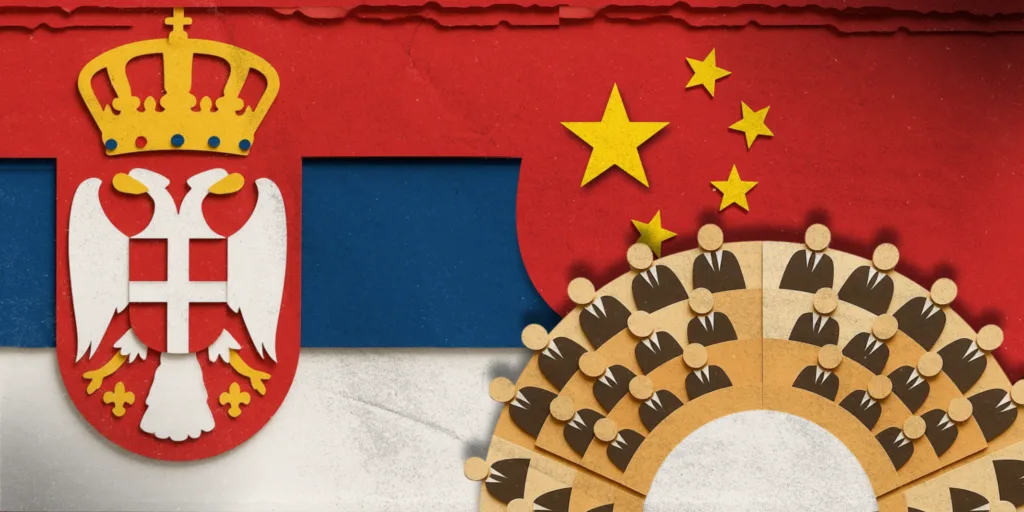
Serbia’s new student-led parliamentary majority has a mandate to scrutinize cooperation with China, but both sides’ interests point to renegotiating the terms of engagement rather than ending it. The test will come when investigations and audits reach contracts tied to jobs, debt and diplomacy.
Key takeaways:
-
Scrutiny, not rupture. The Student List’s victory will bring closer examination of Chinese-linked projects, starting with the Novi Sad canopy case, but jobs, inherited debt and Beijing’s conciliatory signals make a break unlikely.
-
The presidency is the next test. A presidential vote due within three months will help decide how much political room the new authorities have, and whether Beijing keeps a familiar channel at the head of state.
-
Rules matter more than loyalties. Chinese firms can compete under European financing and procurement rules, so the students’ credibility will depend on applying disclosure, procurement and oversight standards consistently, even when the result favors a Chinese company or embarrasses an ally.
For years, Serbia’s partnership with China was centered on development promises: railways, industrial revival, and quickly delivered investment. However, the collapse of the Novi Sad railway station canopy in November 2024 exposed the costs of a system that discouraged questions about those projects. Sixteen people died at a station, which had been renovated as part of a China-backed Belgrade–Budapest railway project. The demand for accountability over this disaster grew into a student movement that won the October 25 parliamentary election.
The movement gained popularity after university students blockaded faculties and demanded accountability, drawing in teachers, lawyers, farmers, and other citizens. Its list, “Student List – Students Win,” carried that mobilization into the ballot, winning more than 52% of the vote in October’s elections and removing from power the regime of Aleksandar Vučić and the Progressive party. After 14 years of rule, the victory came at a time when Vučić had increasingly centralized power, bypassed constitutional boundaries, and was increasingly seen as an emerging, or even fully, fledged autocrat, bringing hope for further democratization of the country under new political leadership.
This matters for Serbia’s China policy because the new parliamentary majority owes its position to demands for transparency and accountability, the same standards that will now be applied to projects negotiated under the previous government.
Although cooperation with China will face greater scrutiny, starting with how Chinese-linked infrastructure contracts were awarded, financed, and disclosed, a rupture in relations remains unlikely. Serbia’s incoming government has more reason to change terms of engagement—open procurement, published contracts, enforced labor and environmental standards, and oversight of security technology—than to dismantle it. Chinese firms employ many Serbian workers, existing loans and contracts remain binding, and European funding is conditional on domestic reform. The main uncertainty is whether the new government can balance tougher scrutiny with continued cooperation when investigations cover politically sensitive contracts and economic interests.
The canopy disaster is a good place to start. The Chinese consortium of state-owned China Railway International (CRIC) and China Communications Construction Company (CCCC) was the main contractor for the railway section from Novi Sad to the Hungarian border. In 2018, the Serbian government awarded the construction work to the two Chinese firms without a public tender. The consortium says the canopy was not part of its reconstruction work. According to Transparency Serbia, the initial disclosures of contracts and annexes had considerable gaps. As of early November, the Supreme Court had still not scheduled a preparatory hearing, as it considered defense challenges to the confirmed indictment. Electoral change has moved faster than judicial accountability.
Nor has Vučić disappeared. The Student List won 140 seats against his bloc’s 103, but another election remains. After Vučić’s September resignation, Ana Brnabić assumed presidential duties, pending a presidential vote within three months. The presidency matters because it is the office through which Vučić cultivated personal ties with Chinese President Xi Jinping. The president also represents Serbia abroad and can return laws to parliament. Moreover, a president aligned with the Serbian Progressive Party (SNS) would preserve a prominent channel for Beijing and give the outgoing camp a platform to contest changes. A student-backed president would make a common approach easier, although the government would still control contracts and spending. China’s political access is being reconfigured, not closed. A student-led government would require Beijing to deal with ministries, parliamentary committees, auditors and courts rather than rely mainly on personal ties at the top, while an SNS-aligned president would keep one familiar channel open.
Beijing’s signals and the students’ position
Beijing has already signaled its preference. On October 26, the Chinese foreign ministry said it was ready to work with the new government on the basis of mutual respect, equality and mutual benefit. At a regular press briefing, the ministry also said that it would not interfere and would respect voters’ choices. China is leaving itself room to protect the relationship without defending every action of its most familiar Serbian partner.
The students’ position allows that room. Their clearest commitment is to review contracts and public spending; their public statements have yet to produce a detailed policy toward China. It would be a mistake to read an anti-corruption mandate as an instruction to align with Western preferences. Their opposition to sanctions against Russia and discussion of an eventual EU membership referendum show that institutional reform and geopolitical alignment are separate questions within the movement.
Jobs, debt and security
Economic interests reinforce continuity. HBIS’s steelworks in Smederevo and Zijin’s copper operations tie Chinese companies to Serbian employment and exports. The free trade agreement has been in effect since July 2024. For workers in Bor or Smederevo, the new government cannot leave their livelihoods uncertain while it decides how Chinese investment fits its foreign policy. Enforcing labor and environmental standards offers a more defensible political course than blanket cancellation because it tightens the terms of cooperation without ending it, a balance the new authorities will need to sustain.
Debt creates another layer. The Export-Import Bank of China financed railway construction, leaving obligations that survive an election. An audit can expose inflated costs or oversight failures without automatically removing repayment obligations. The Belgrade–Budapest railway therefore brings together several different decisions: investigating wrongdoing, meeting financial commitments and operating infrastructure already built. Treating them as one decision would weaken Serbia’s negotiating position, because a finding of wrongdoing in the construction contract would not cancel the loan, and a government seen to use an audit to avoid repayment would lose credibility with lenders and with Brussels.
Chinese firms can also adapt to more competitive conditions: as Chinese loans recede and European institutions finance more projects, more contracts are awarded through open tenders rather than bilateral agreements. Across the Western Balkans, Chinese contractors increasingly work on projects without Chinese loan financing. Instead, European Bank for Reconstruction and Development loans, EU grants, and other European financing, or private investment and concessions, fund these projects. In Montenegro, for example, European institutions are financing the second section of the Bar–Boljare highway, which a Chinese consortium is building. A shift toward European finance would therefore not necessarily remove them from Serbia’s infrastructure market. For the students, this makes the procurement process especially important. If a Chinese company wins an open competition and meets the requirements, accepting that outcome would demonstrate confidence in the rules they promised to restore.
Hungary offers a useful warning. Prime Minister Péter Magyar’s government inherited Chinese investments and the same railway after defeating former prime minister Viktor Orbán in elections earlier this year. Several analysts’ assessment of the transition describes a loss of political privilege without a wholesale economic reversal but also notes that the Budapest–Belgrade railway contract remained unpublished in early October. A government that won on a promise of transparency can still struggle to publish agreements its predecessors negotiated. Serbia’s students will face similar pressure to accept partial transparency as sufficient progress, for example when officials argue that publishing a summary or part of a contract is enough to avoid delaying a project or straining relations with Beijing, although the movement’s original demand after Novi Sad was full documentation.
Security cooperation will be harder to defend on job-creation grounds because, unlike the steelworks or copper mines, it supports little local employment; its justification rests on security and oversight rather than economic benefit. Reporting on Huawei’s Safe City system documented purchases to expand surveillance capacity, while Serbian authorities maintained that facial recognition was not deployed. That distinction matters; technical capacity is not proof of use. Still, a movement shaped by confrontation with the security apparatus has a direct interest in establishing what was purchased, who can access it and what oversight exists. This is one area where cooperation could narrow because no workforce depends on it, even while industrial ties continue.
Here the relationship between the movement and its government becomes consequential. Ministers may defend an inherited system as operationally necessary, just as they may defend a construction contract as too expensive to exit. Students outside government must decide whether those explanations meet their original demands. Their influence will last longer if they can challenge such decisions without every dispute becoming a test of loyalty to the people they helped elect. In practice, that would mean questioning a ministry’s decision on a Chinese contract, requesting the underlying documents or calling for an independent review, and being heard as a watchdog rather than treated as an opponent of the government.
Europe’s offer
Europe can make these choices less restrictive. Serbia’s €1.58 billion allocation under the Growth Plan, the EU’s €6 billion reform-linked funding scheme for the Western Balkans (2024–2027), provides a concrete route to budget and infrastructure support. However, payments depend on reforms and other conditions, including constructive engagement in normalization with Kosovo. This is neither an immediate replacement for Chinese finance nor a reward automatically unlocked by an election. Delivering the agreed reforms would give the new government more financial options and a stronger negotiating position with all investors.
The likeliest outcome is continued cooperation, with more disputes over disclosure, compliance and individual projects. That forecast would weaken if Chinese partners resisted investigations, if evidence of serious misconduct made particular agreements politically untenable, or if the new authorities abandoned scrutiny to secure quick investment. The presidential election will influence how much political room they have to pursue their agenda.
The students have won the opportunity to make Serbia’s institutions matter. Whether they can do so will become clear when publishing a contract embarrasses an ally, an inspection delays a promised investment, or an investigation complicates relations with Beijing. China will remain part of Serbia’s economy. The harder achievement will be making it answer to rules that survive the next election too.