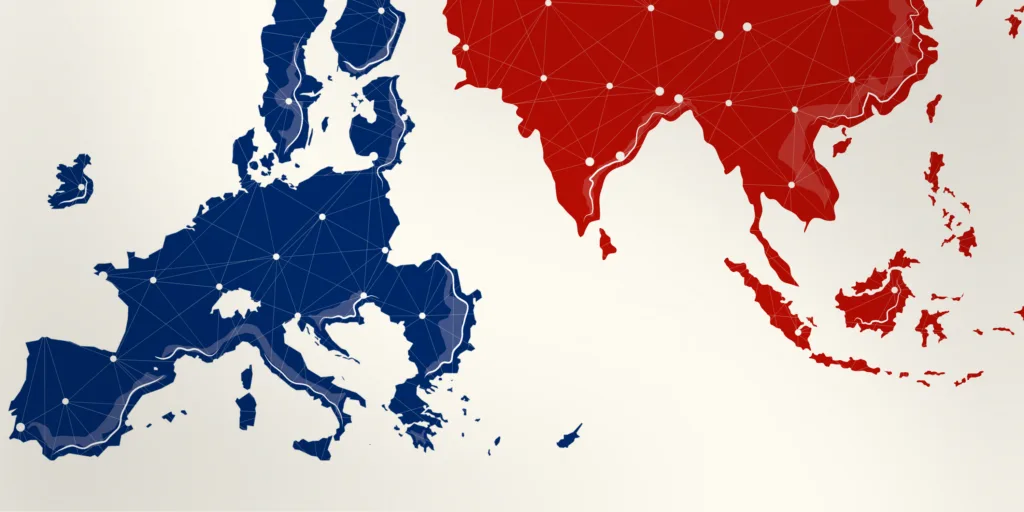
As rivalry between major powers intensifies, middle powers are becoming increasingly important in preserving regional stability and sustaining international cooperation. Across Europe and the Indo-Pacific, countries are turning to networks, partnerships and flexible coalitions to protect their interests while maintaining strategic autonomy. Their success may shape the future international order as much as great-power competition itself.
Key takeaways:
-
Middle powers increasingly exercise influence through networks and flexible frameworks such as ASEAN- and EU-led mechanisms, the Comprehensive and Progressive Agreement for Trans-Pacific Partnership (CPTPP), and issue-specific security and technology partnerships rather than solely through traditional power resources.
-
Europe and the Indo-Pacific face increasingly interconnected security, economic and technological challenges.
-
Practical cooperation among middle powers on issues such as maritime security, technology, supply chains and international law can strengthen stability even when formal alignment is impossible.
Since the late 2010s, discussions of international politics have increasingly been framed as a contest between great powers, even though cooperation among major powers remained a defining feature of the international order for much of the post-Cold War period.
Strategic competition between the United States and China, Russia’s war against Ukraine, and growing tensions across the Indo-Pacific have reinforced the perception that the future of the international order will be decided primarily in Washington, Beijing, and Moscow.
Yet this narrative overlooks an increasingly important reality. Across Europe and the Indo-Pacific, middle powers are playing an increasingly important role in shaping regional stability, strengthening international institutions, and building practical cooperation that transcends geopolitical divides.
Japan provides one of the clearest examples. Over the past decade, Tokyo has played a central role in promoting the Free and Open Indo-Pacific while strengthening partnerships across Asia, Europe, and beyond. Australia has similarly built an extensive network of security and economic relationships, including through AUKUS and the Quad, that amplifies its influence far beyond what population size alone might suggest.
South Korea offers another illustration of networked influence. Through its Indo-Pacific Strategy and growing engagement with European partners, Seoul has sought to strengthen cooperation on critical technologies, supply-chain resilience and economic security, demonstrating how middle powers can shape strategic sectors of the global economy without relying primarily on military power.
The Association of Southeast Asian Nations (ASEAN) illustrates a complementary form of networked influence. As a regional organization rather than a middle power in its own right, it provides institutional platforms through which its diverse member states can engage regional and global actors. ASEAN’s diplomatic centrality shows how regional institutions can amplify members’ collective influence, even when those members differ in strategic priorities and capabilities.
As Southeast Asia’s largest economy and a key advocate of ASEAN centrality, Indonesia plays a significant role in sustaining this convening function and promoting dialogue among competing powers. Vietnam’s diplomatic approach is equally illustrative. Hanoi has expanded strategic partnerships with the United States, Japan, India, Australia, and several European partners, while maintaining close ties with China. Its policy of “bamboo diplomacy” reflects an effort to deepen international cooperation while preserving strategic independence.
The world is not returning to the Cold War
The growing rivalry between major powers has encouraged comparisons with the Cold War. While such parallels are understandable, they can also be misleading.
The contemporary international system is far more interconnected and complex than the twentieth-century bipolar world. Most countries are neither willing nor able to align exclusively with one geopolitical camp. Security, trade, investment, technology, and climate policy increasingly require engagement with multiple partners at the same time.
This reality is particularly visible in the Indo-Pacific. Countries throughout the region seek strong security partnerships with the United States while maintaining extensive economic relations with China. Many support a rules-based international order but also strive to preserve strategic autonomy and avoid becoming instruments of larger powers.
A similar dynamic is increasingly evident in Europe. Russia’s invasion of Ukraine has strengthened transatlantic cooperation and reaffirmed the importance of collective defense. At the same time, European countries are seeking to diversify economic partnerships, strengthen technological resilience, and deepen engagement with partners across Asia.
As a result, the international environment is no longer defined simply by alignment or non-alignment. Instead, many states pursue flexible strategies to maximize security, prosperity, and diplomatic maneuverability. In this context, middle powers have gained renewed significance.
The rise of networked influence
Middle powers have traditionally faced a structural challenge. Their economic and military resources are insufficient to shape international outcomes independently, yet they are often
too economically significant, diplomatically active, or strategically located to accept a purely passive role in world affairs.
They have increasingly responded by exercising influence through networks. Unlike great powers, which often rely on unilateral capabilities, middle powers derive much of their strength from coalition-building and institution-building. Their influence stems not from domination but from their ability to convene, connect, and coordinate. This strategy reflects a broader trend among many middle powers: maintaining flexibility while expanding cooperation.
Finland’s President, Alexander Stubb, recently captured this dynamic in his address to the 81st Session of the United Nations General Assembly. He warned against the emergence of a non-cooperative multipolar order and highlighted the growing importance of flexible coalitions, regional organizations and partnerships in preserving stability. Stubb argued that while such arrangements cannot replace multilateral institutions, they can reinforce them and help sustain cooperation in a more fragmented international environment.
The common thread across these examples is the recognition that influence depends on connectivity. In a world defined by economic interdependence and transnational challenges, the ability to build partnerships has become a key source of strategic leverage.
Europe and the Indo-Pacific share more than ever before
One of the most significant geopolitical developments of recent years has been the growing convergence between European and Indo-Pacific security. For decades, policymakers often treated developments in Europe and Asia as largely separate. That distinction is becoming increasingly difficult to sustain.
Russia’s invasion of Ukraine demonstrated how a conflict in one region can produce global consequences. The conflict affected energy markets, food security, supply chains, and strategic calculations across continents. Similarly, instability in key Indo-Pacific maritime routes would immediately affect European economies that depend heavily on trade passing through the region.
The same logic applies to technology and economic security. Finland offers a practical illustration of this trend. Finnish expertise in telecommunications, microelectronics and emerging 6G technologies depends heavily on stable global supply chains, open markets and international research cooperation. Dependencies on critical minerals, semiconductors, telecommunications infrastructure, and other strategic sectors increasingly link developments in Europe and Asia.
Many Central European countries face challenges similar to those confronting Indo-Pacific middle powers: dependence on open markets, exposure to geopolitical competition, and a strong interest in preserving a rules-based international order.
Slovakia’s publication of its Indo-Pacific Strategy and its growing diplomatic engagement with partners such as Japan, South Korea, and ASEAN member states illustrate how even geographically distant European countries increasingly recognize the region’s strategic relevance. For countries whose prosperity depends on open trade, globally integrated supply chains and advanced manufacturing, developments in the region have direct implications for economic resilience and security. Support for a rules-based international order, freedom of navigation, technological cooperation and diversified partnerships has therefore become an increasingly important element of long-term prosperity and stability.
While preparing Finland’s Indo-Pacific Policy Guidelines, one interesting observation was how often discussions with Central European colleagues returned to questions familiar to policymakers in Tokyo, Seoul or Jakarta. Concerns about supply chains, economic coercion, technological competitiveness and strategic autonomy increasingly transcend geography.
Finland’s recently published Indo-Pacific Policy Guidelines reflect this same reality. They are based on the recognition that European security, economic resilience, technological competitiveness, and Indo-Pacific developments are increasingly interconnected. For European countries, engagement with the Indo-Pacific is no longer primarily a matter of geography; it is a strategic necessity.
Whether in Central Europe or the Indo-Pacific, middle powers increasingly confront similar strategic questions. How can countries maintain economic openness while reducing strategic vulnerabilities? How can countries protect themselves against economic coercion without undermining globalization? How can international law be defended amid growing geopolitical competition? And how can states cooperate across regions without becoming trapped in bloc politics?
The answers are likely to require greater cooperation between middle powers on both sides of Eurasia. Increasingly, these countries view one another not simply as distant partners but as stakeholders in a common effort to preserve stability, resilience, and openness.
The limits of middle-power cooperation
Recognizing the growing role of middle powers does not mean romanticizing their capabilities. Middle powers vary significantly in their interests, economic structures, threat perceptions, and political priorities. What seems urgent in Northern or Central Europe may not be seen the same way in Southeast Asia. Likewise, countries that depend heavily on certain trade relationships may pursue different strategies from those facing immediate security challenges.
These differences naturally limit cooperation. Therefore, expecting middle powers to form a unified geopolitical bloc is unrealistic. Their diversity is both a strength and a constraint. Yet meaningful cooperation does not require complete unity.
Middle powers are often most effective when they focus on practical objectives rather than grand strategic visions. Maritime security, supply-chain resilience, technological cooperation, disaster response, infrastructure development, and support for international law are all areas where countries with otherwise different priorities can find common ground.
This flexibility distinguishes middle-power diplomacy from the rigid alliance structures that characterized earlier eras. Indeed, adaptability may prove one of its greatest advantages. Middle-power status is therefore best understood here as an analytical perspective on how states exercise influence, rather than as a fixed category in which all countries share the same capabilities or strategic outlook.
Why middle powers matter more than ever
Periods of strategic tension naturally draw attention to major powers’ decisions. Their actions undoubtedly shape the international environment and will continue to do so. However, focusing exclusively on great-power rivalry risks overlooking one of the most important developments in contemporary geopolitics.
Middle powers have become essential actors in managing the consequences of fragmentation. They often bridge regions, institutions, and competing political perspectives. They help sustain dialogue when relations among larger powers deteriorate. They strengthen international organizations and norms that provide predictability in an uncertain world. Most importantly, they show that influence is not determined solely by size.
As President Stubb noted in his 2026 address to the United Nations, small and medium-sized countries derive much of their influence from cooperation, while regional organizations and flexible coalitions can build trust during periods of uncertainty and geopolitical realignment.
The ability to forge partnerships, mobilize coalitions, and generate trust has become an increasingly valuable strategic asset. In an interconnected international system, countries that can connect different actors and regions possess a form of influence that traditional measures of power often fail to capture.
The future international order will certainly be shaped by the decisions made in Washington, Beijing, and Moscow. Yet it will also be influenced in Tokyo, Seoul, Canberra, Jakarta, Hanoi, Singapore, Helsinki, Bratislava and numerous other capitals whose governments are working to preserve stability amid growing uncertainty.
Finland’s Indo-Pacific approach reflects a broader lesson for middle powers. Geography remains important but influence increasingly depends on the ability to build partnerships across regions, sectors, and institutions. In a fragmented world, the most effective states may not be those with the greatest power resources, but those best able to connect with others.
The age of middle powers has not replaced the age of great powers. But as geopolitical competition intensifies, their role in preserving cooperation, supporting international norms, and linking regions is becoming ever more significant. The future international order will be shaped not only by competition among major powers, but also by middle powers’ success in keeping cooperation possible despite it. In an era increasingly defined by fragmentation, networks may ultimately prove as important as states themselves.