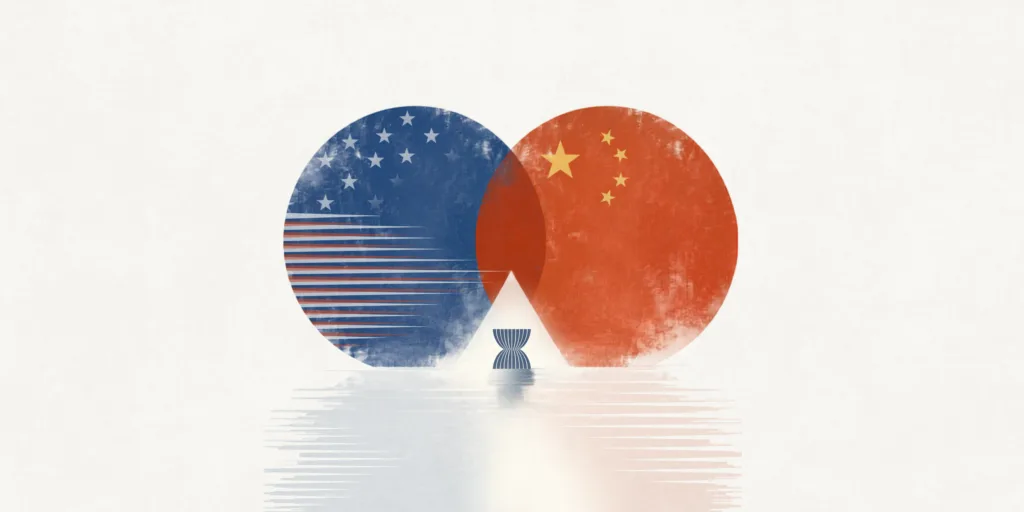
Trapped between an unpredictable Washington and a distrusted Beijing, Southeast Asia refuses to pick sides.
Key takeaways:
-
The United States will remain a central security and economic actor in Southeast Asia during President Trump’s second term, although its approach to the region will continue to be driven by unilateralism and transactionalism.
-
The more critical view of the Trump administration in the region, notably its unpredictability and inconsistency, is accompanied by more positive perceptions of China. However, China, too, will continue to be viewed with suspicion in many Southeast Asian countries, notably in the Philippines and Vietnam.
-
The Southeast Asian governments will therefore continue to avoid making a clear strategic choice between China and the United States. They will, as before, instead pursue a hedging strategy. This has so far served them well as they adapt to rapidly changing geopolitical and geoeconomic realities.
Introduction
In principle, thanks to their realist and pragmatic view of global politics and the hedging strategies pursued by the majority of Southeast Asian governments, these governments were better prepared to deal with the Trump 2.0 administration than their European counterparts. Southeast Asia has traditionally sought friendly relations with both the United States and China, while also cooperating with many other partners to reduce the risk of dependence on a single major power. Nevertheless, there were concerns from the outset that Southeast Asia, due to its substantial trade surplus with the United States, could fall victim to US President Donald Trump’s transactional economic policies.
Indeed, Trump’s “reciprocal tariffs”, announced in April 2025, shook the Southeast Asian export-oriented economic model of success to its very foundations. Even longstanding partners such as Vietnam (tariffs of 46%), Thailand (36%), Indonesia (32%), Malaysia (24%), and the Philippines (17%) were hit hard. At 10 percent, Singapore got off relatively lightly. Although the tariffs were later lowered after they were deemed unconstitutional, their announcement raised fundamental concerns about Washington’s commitment to maintaining the rules-based international order and the stability of US partnerships in Southeast Asia and the Indo-Pacific at large.
Critical views of the US and more positive perceptions of China in Southeast Asia
According to the Singapore-based ISEAS – Yusof Ishak Institute’s 2026 annual expert poll, the main geopolitical concern in Southeast Asia is the US leadership under Trump (51.9%), notably its lack of respect for the rules-based international order. Close behind are global scam operations (51.4%)—many of which originate within the region—and aggressive behavior in the South China Sea (48.2%). Although the latter is mostly attributable to China, there are also critical views of increased military engagement by the United States and non-regional actors.
By contrast, China is viewed more positively in Southeast Asia (and globally). According to the latest Pew Research Center representative survey conducted in March 2026 across 20 countries, respondents now view China more positively than the United States, at 46% compared to 36%. In 2025, 48% of those surveyed held a favorable view of the United States, 38% of China. A NIRA general survey, conducted in spring 2026 in 85 countries, confirms the pattern of China’s improved image, while the perceptions of the United States become increasingly negative.
Opinions about China are especially polarized in the Indo-Pacific. Some 90% of Pakistani respondents view China favorably, whereas 88% of Japanese respondents view it unfavorably. Beyond Japan, respondents in key US partners such as Australia, India, and South Korea also view the United States more favorably than China.
The Philippines is the only Southeast Asian country in which a majority of respondents view the United States favorably (57%, compared with 40% for China), according to a Pew Research Center survey. In the other four countries surveyed, China leads by a wide margin. In Malaysia, the disparity is most pronounced: only 25% view the United States favorably, compared with 75% for China. In Indonesia, 28% view the United States favorably, compared with 72% for China. In 2023, those figures were 55% and 49%, respectively. In Singapore, 27% view the United States favorably, compared with 73% for China. In Thailand, 30% view the United States favorably, compared with 69% for China.
While less pronounced, the critical views of the United States in Malaysia reported by the Pew Research Center align with a large, representative 2022 survey commissioned by Palacký University Olomouc across 15 Indo-Pacific countries. That survey also found very favorable views of the United States in the Philippines and Vietnam (84% each) and net-positive ratings in Thailand (also 84%), Indonesia, and Singapore. This makes the rapid deterioration of these indicators in these three countries all the more stunning.
Striking differences emerge when people are asked whom they trust more to do the right thing in world affairs: Chinese President Xi Jinping or Trump. Across the five Southeast Asian countries surveyed by the Pew Research Center, the Philippines is the only case in which confidence in Trump is higher than in Xi: 68% versus 50%, an 18-point advantage for Trump. In the other four countries, Xi leads by wide margins: Malaysia (66% versus 13%, +53 points for Xi), Singapore (67% versus 19%, +48), Indonesia (62% versus 20%, +42), and Thailand (53% versus 19%, +34).
However, the more positive views of Xi do not translate into a clear strategic preference for China. According to the ISEAS – Yusof Ishak Institute survey, China is, for the second time since 2024, the preferred great power if Southeast Asia were forced to choose between China and the United States. However, the margin is narrow: 52% for China and 48% for the United States. In 2024, the split was even tighter and within the margin of statistical error, at 50.5% to 49.5% in China’s favor. Thus, experts in the region remain divided over their strategic preferences for one of the two great powers, underscoring the need to avoid being forced into such a costly choice.
One reason is that while the Trump administration’s commitment to the rules-based order is rightly being called into question, confidence in China as a champion of international law is not that high either, not least due to Beijing’s assertive behavior in the South China Sea. Across Southeast Asia, views of China as the leader of the Global South are cautiously positive but not decisive. According to the ISEAS – Yusof Ishak Institute survey, 41.9% of respondents have confidence (or strong confidence), 29% express little or no confidence, and 29.1% offer no comment. Even in Indonesia and Malaysia, confidence values are below 45%.
Washington’s good cop, bad cop approach toward Southeast Asia
The United States is here to stay in the Indo-Pacific and Southeast Asia. It will remain a crucial security partner and arms provider for countries such as Singapore, Thailand, the Philippines, and Vietnam. And even though China is the main trading partner of the Southeast Asian nations, the United States is a major economic partner, having traditionally been the main investor in Southeast Asia, ahead of the European Union and China.
However, as outlined in the National Security Strategy of 2025, the Trump administration increasingly views Southeast Asia from a geostrategic angle, as a key region for the military and economic containment of China. It is therefore no coincidence that Secretary of War Pete Hegseth reaffirmed Washington’s “ironclad commitment” to the US-Philippines Mutual Defense Treaty. The Philippines occupy a pivotal position in the First Island Chain, which includes Taiwan and runs along the South China Sea, hindering China’s access to the Pacific Ocean.
At the Shangri-La Dialogue in Singapore in June 2026, Hegseth played “bad cop,” warning US allies not to “free ride on the generosity of the American taxpayer” and urging greater investment in their own security and defense, while Rubio presented a friendlier face for the Trump administration in July 2026. During his visit to the ASEAN Regional Forum meeting in July 2026, Rubio emphasized Washington’s commitment to remain a reliable and durable partner for Southeast Asia. Together with President Trump’s appearance at the ASEAN Summit in Malaysia in October 2025, these engagements helped clarify the US approach to the region.
Conversely, Southeast Asia “is not turning away from Washington, [but] it is becoming less assured by the direction of US leadership”. Singapore Prime Minister Lawrence Wang, a long-standing US partner, was among the first Southeast Asian politicians to respond to the geopolitical and geoeconomic challenges, further intensified by Trump’s return to the White House and China’s foreign policy and military buildup. He stressed that Southeast Asia does not want a world divided into competing spheres of influence and wants to avoid being forced to choose between the United States and China; he stated that these two great powers are increasingly doing so.
Wang seemed to articulate the consensus view in Southeast Asia that the United States under Trump is no longer upholding the rules-based order, which has been the foundation for peace, stability, and economic development in the region. However, rather than aligning with Beijing, Southeast Asia has deepened its hedging strategy since 2025, aiming to balance its relations with China and the United States.
Conclusion
President Trump’s unpredictability and inconsistency, especially on trade, have jolted export‑dependent Southeast Asia. This is compounded by widespread criticism of his foreign policy, from intervention in Venezuela and the war against Iran to steadfast support for Israel. The latter is notably contested in Brunei, Malaysia, and Indonesia.
Skepticism toward the Trump administration coincides with a somewhat more positive view of China among local citizens and experts, yet recent surveys show Beijing’s policies still elicit significant mistrust across the region. Despite increasingly favorable perceptions, China has not been able to win over the hearts and minds of the people of Southeast Asia, let alone in the broader Indo-Pacific. Cooperation with China is therefore driven by shared interests rather than shared values. And while the United States under Trump is no longer seen as a reliable guarantor of the rules‑based order, neither China—nor any other country—appears willing or able to fill the vacuum and provide the kind of leadership the US did in the past. For instance, China failed to support Southeast Asian countries in overcoming fuel and fertilizer shortages caused by the war in Iran. Fears that the Trump policies would push the region firmly toward China are therefore overstated.
Over the past two decades, Southeast Asia has adapted to the reality that the defining US–China rivalry is here to stay. Hedging therefore remains Southeast Asia’s strategy of choice: a pragmatic, flexible approach to navigating the policies of both Washington and Beijing. Stronger diversification of economic and security ties, based on closer cooperation with like‑minded partners, including the European Union, would further bolster this approach.
The research has been funded by the EU NextGeneration through the Recovery and Resilience Plan for Slovakia under the project No. 09I03-03-V04-00595.