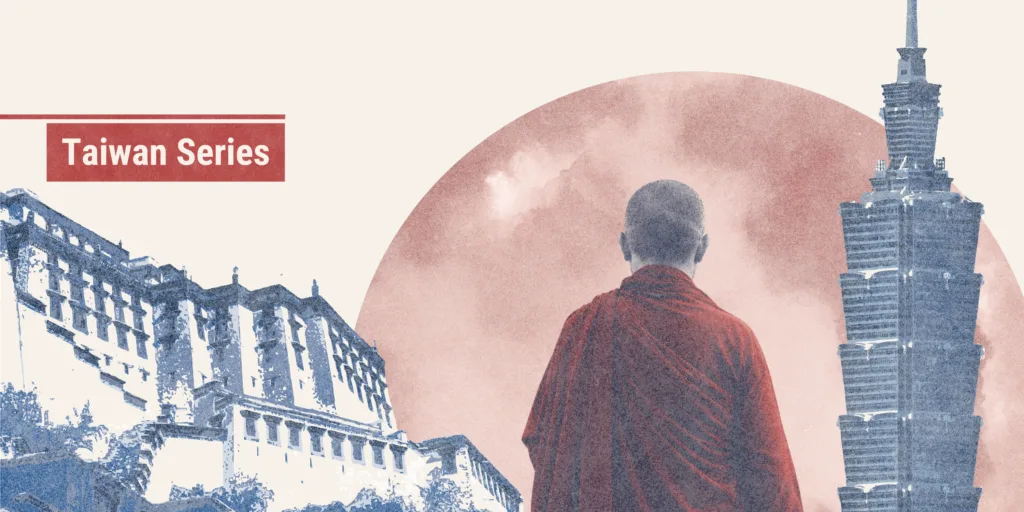
Taiwan is widely celebrated as one of Asia’s leading democracies. Yet its treatment of Tibetan Buddhist monks reveals a quieter contradiction. While religious practice is permitted, access to basic rights remains restricted—driven less by legal status than by a security logic shaped by cross-Strait tensions. The result is a system in which monks can enter, but cannot fully belong.
Key takeaways:
-
Taiwan’s restrictions on Tibetan monks are not only about statelessness—they persist even when monks acquire citizenship, indicating a deeper security logic.
-
Security concerns are applied collectively rather than individually, despite the state’s own evidence distinguishing genuine risks from the broader monastic population.
-
Taiwan enables religious practice but denies the legal and social rights necessary to sustain it.
Since its transition to democracy, marked by its first direct presidential election in 1996, Taiwan has established itself as one of Asia’s most vibrant democracies, ranging according to Freedom House’s latest report, eighth among the freest societies in the world and second in Asia. Yet within this success story lies a quieter contradiction. Members of Taiwan’s Tibetan Buddhist community have repeatedly raised concerns about the denial of basic rights, including residence, employment, freedom of movement, and access to healthcare. At the center of this tension is the securitization of Tibetan Buddhist monks, a process shaped by the complex nexus of Taiwan’s strained relationship with the People’s Republic of China (PRC), the very state many of these monks fled, and the precarious legal condition of statelessness that many continue to carry.
Beijing’s campaign against Tibetan Buddhism
To understand Taiwan’s securitization of Tibetan Buddhist monks, it is essential to situate it within the history of Tibetan Buddhism under the PRC, as well as the migration trajectories this history has produced—from Tibet to India and Nepal, and eventually to Taiwan.
Following the Chinese occupation of Tibet in 1950 and the suppression of the 1959 uprising, Beijing began systematically reframing Tibetan Buddhist institutions not merely as religious sites, but as repositories of Tibetan identity and sources of potential challenge to state legitimacy. In this context, religion became inseparable from questions of political loyalty and security. This process reached its most extreme form during the Cultural Revolution, when the Chinese government destroyed over 97% of monasteries and nunneries, and the monastic population declined by more than 90%. Tibetan Buddhism was not simply restricted; it was nearly eradicated as a functioning institutional system.
Although Deng Xiaoping’s Reform and Opening Up period introduced a degree of religious tolerance, this proved short-lived. By the 1990s, securitization had re-emerged in a more sophisticated and enduring form. Rather than relying on outright destruction, the Chinese state developed a system of pervasive control: direct administrative supervision, monks were subjected to mandatory political education, and surveillance became embedded in everyday religious life. Perhaps most strikingly, the state asserted authority over the recognition of reincarnated lamas, in intervention into the doctrinal core of Tibetan Buddhism itself. Under Xi Jinping’s policy of “Sinicization,” these measures have only deepened, producing an environment in which religious practice is tightly constrained, and expressions of Tibetan identity are closely monitored.
It is from this system of control that thousands of Tibetan Buddhist monks have fled, seeking not only safety but the ability to practice their religion freely. Many have found their way to Taiwan.
From welcome to suspicion: Tibetan monks in Taiwan
Before democratization, Taiwan had only a limited Tibetan Buddhist presence. The Dalai Lama’s first visit in 1997 marked a turning point, coinciding with intensifying repression in Tibet. Taiwan quickly emerged as a new center for Tibetan Buddhist practice. The expansion was rapid—from only a handful of centers to over 100 by 1999, and more than 400 today—serving an estimated half a million followers. By 2018, more than 2,000 Tibetan Buddhist monks were entering Taiwan annually for religious purposes. Yet for the monks themselves, this apparent openness has come with an invisible ceiling, shaped by the tightening of Taiwan’s border controls amid growing cross-Strait tensions. Religious practice remains free, but access to fundamental rights does not.
In June 2023, more than 112 Tibetan Buddhist centers held a joint press conference accusing the Taiwanese government of religious discrimination and calling for equal treatment. They highlighted that Tibetan monks are typically granted only short-term visitor visas of two to three months. Even when invited for longer stays, they must leave Taiwan, reapply, and return—an exhausting and costly cycle with no clear pathway to stability. Crucially, they are denied residency permits, which prevents them from opening bank accounts or accessing Taiwan’s national healthcare system. Although authorities extended visa validity to six months following the press conference, the underlying issue remains unresolved. In the terms of political philosopher Giorgio Agamben, these monks are reduced to “bare life”—a form of existence stripped of legal personhood and political recognition.
Taiwanese authorities justify these restrictions by pointing to the stateless status of many Tibetan monks, who travel on Indian-issued Identity Certificates rather than passports. The experience of one monk interviewed by one of the authors—who has lived in Taiwan for seven years and spoke on condition of anonymity—illustrates this clearly. Despite years of devoted service to his religious community, he remained unable to obtain residency, healthcare, or even open a bank account. Hoping that formalizing his legal status might resolve the situation, he later acquired Indian citizenship. Nothing changed: the same restrictions applied, and the same barriers remained. This fact is more revealing than any policy document. If statelessness were the operative concern, citizenship would have resolved it; that it did not points to a deeper dynamic.
Taiwan’s 2006 crackdown on fake lamas identified a specific, traceable threat: nationals of the PRC disguising themselves as monks and entering Taiwan on Nepali passports, many issued by the Nepali consular office in Beijing. This pattern was not observed among stateless Tibetans monks from India. Applying blanket restrictions to all Tibetan Buddhist monks—regardless of their documentation, citizenship, or years of residence—is therefore not a proportionate security response; it is collective suspicion dressed in administrative language.
Taiwanese authorities can plausibly argue that such restrictions reflect legitimate security concerns. The risk of infiltration by actors linked to the PRC is difficult to assess with precision, particularly when individuals may use religious identities strategically and documentation can be unreliable. In this context, broad administrative measures may appear as a precautionary response to high-impact but low-visibility threats. Yet even under conditions of uncertainty, security policy must remain proportionate and evidence-based. Taiwan’s own findings from the 2006 crackdown identified specific patterns of abuse that do not extend to the broader population of Tibetan monks from India. Applying generalised restrictions in the absence of comparable evidence does not reduce risk in a targeted way; it merely expands it indiscriminately, at the cost of both effectiveness and fundamental rights.
Taken together, the issue is not the existence of security concerns, but how they are translated into policy. When broad restrictions persist despite evidence allowing for differentiation, they reflect not a lack of information but a particular interpretation of risk. What emerges, then, is that the securitisation of Tibetan Buddhist monks in Taiwan is not primarily about legal status. Rather, it reflects a deeper logic rooted in cross-Strait tensions, in which Tibetan identity itself—regardless of the documents a monk carries—is read through the lens of the China threat.
Aligning policy with principle: Taiwan’s path forward
Taiwan possesses both the democratic mandate and the institutional capacity to address this issue in a principled and practical manner. First, monks holding citizenship in India, Nepal, or Bhutan should be formally recognized as foreign nationals rather than treated as de facto stateless persons, ensuring equal treatment under existing legal frameworks and ending arbitrary administrative exclusion.
Second, denying fundamental rights on the basis of statelessness risks conflicting with international human rights standards Taiwan has voluntarily embraced, including the International Covenant on Economic, Social and Cultural Rights (ICESCR) and the Convention on the Elimination of All Forms of Racial Discrimination (CERD). Taiwan could address this through Article 16 of the Immigration Act or by developing a tailored legal framework. Democratic partners such as Germany, Switzerland, and Czechia have already established pathways for religious workers from stateless communities. Taiwan’s own history of legal innovation in accommodating complex cases suggests such reforms are entirely feasible.
Third, where restrictions are justified on national security grounds, they must be transparent, individualized, and proportionate. Legitimate concerns can—and should—be addressed on a case-by-case basis through existing mechanisms, rather than through generalized restrictions affecting an entire religious community whose members have been clearly distinguished from documented security threats by the government’s own evidence.
As China intensifies its control over Tibetan Buddhism, Taiwan has become one of the few places where the tradition can be practiced freely. That makes Taiwan’s current approach all the more consequential, and all the more worth examining honestly. Democracy is not measured only by the political and civil liberties it extends to its own citizens, but by how it treats those at its margins. Taiwan has already demonstrated a capacity for legal innovation and a genuine commitment to civil liberties. Extending that commitment to Tibetan Buddhist monks, ensuring access to residency, healthcare, and freedom of movement, would do more than resolve a policy inconsistency. It would reaffirm Taiwan’s identity as a democracy that is not only free, but fair.