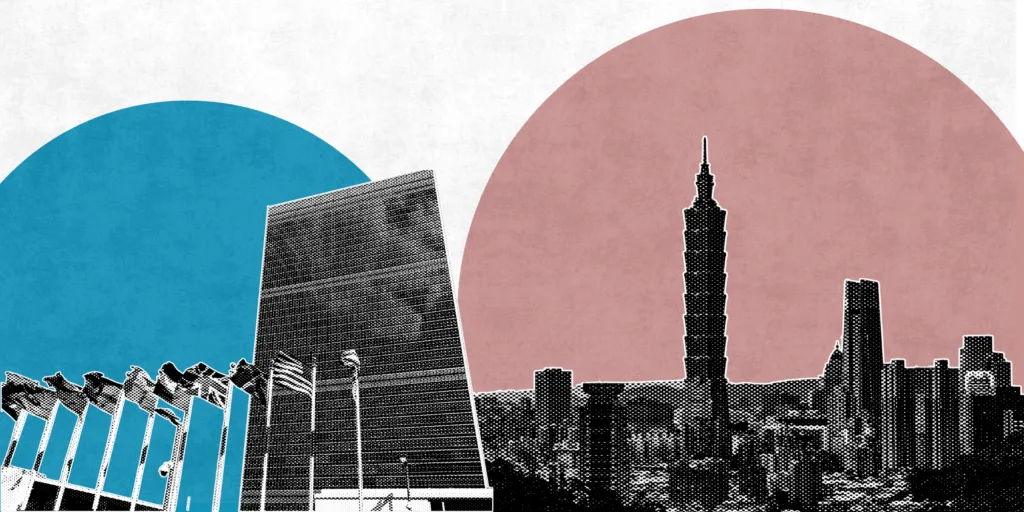
On September 19, 2026, days before the high-level debate of the 81st United Nations General Assembly opened in New York, Taiwan launched the World Alliance for Disaster Management (WADM) in Taipei. President Lai Ching-te described WADM as “the first intergovernmental organization spearheaded and established by Taiwan in 55 years.” While Taiwan’s diplomatic allies again called for its inclusion at the General Assembly, Taipei was also convening its own forum. Taken together, the two efforts reveal both the uses and the limits of Taiwan’s soft power.
Key takeaways:
-
Taiwan’s 2026 UN season unfolded on two tracks: a familiar campaign for participation in New York and a new effort to convene disaster-management cooperation in Taipei, the latter drawing on a narrative of reciprocity for the assistance Taiwan received after the 1999 earthquake.
-
Whereas Taiwan’s diplomatic allies emphasized people, partnership, and participation, non-allies used the language of resilience, preparedness, and stability across the Taiwan Strait. This vocabulary can normalize cooperation without requiring governments to change their positions on Taiwan’s international status.
-
WADM’s formal structure still reflects diplomatic recognition: its 13 founding members are Taiwan, 11 of its diplomatic allies, and Somaliland, while bodies from countries that do not recognize Taiwan –from central and local government offices to disaster-management agencies and other organizations – join as observers or partners. For Central Europe, engagement through such agencies offers the most practical entry point.
Two tracks in one month
The New York track followed a well-rehearsed script. On September 2, Taiwan’s Foreign Ministry outlined a plan centered on a joint letter from allied ambassadors to the UN secretary-general, speeches by allies during the General Debate, a ministerial op-ed, side events, a New York campaign, and a cross-party legislative delegation. Its “Chip in with TAIWAN” slogan paired the General Assembly’s theme with a claim about the 23.5 million people left outside the system and Taiwan’s role in semiconductor supply chains.
The second track had a Pacific prelude. Foreign Minister Lin Chia-lung visited Palau around the Pacific Islands Forum leaders’ meeting, where he discussed plans for a new national hospital and marked the launch of a Taiwan-Palau Hydrogen Initiative. The centerpiece was in Taipei, where WADM launched alongside the Resilient Taiwan for Sustainable Democracy International Forum, a gathering hosted by the Presidential Office’s Whole-of-Society Defense Resilience Committee, which Lai set up in 2024 to strengthen society’s resilience against both disasters and military threats. Official Taiwanese reporting lists 13 founding members, 17 observers, and 11 partners, and describes plans for joint training, exercises, operations, and information sharing.
The two tracks address the same constraint in different ways. One seeks greater participation in an institution where Beijing holds a decisive procedural advantage. The other builds a forum in which Taiwan hosts, convenes, and shapes practical cooperation. It does not replace the UN campaign, but it could make Taiwan’s international engagement less dependent on a breakthrough within the UN system.
What the allies said
The General Debate again gave Taiwan’s diplomatic allies a platform. Paraguay called Taiwan’s exclusion “a stain on the United Nations.” Palau sought “the reversal of misinterpretations of rules and procedures that have constrained Taiwan’s meaningful participation.” Eswatini called on the UN to facilitate Taiwan’s substantive participation, while the Marshall Islands warned that Resolution 2758 was being misused as a pretext for coercion against Taiwan.
Belize made the case in developmental terms. Prime Minister John Briceño spoke of Taiwan’s 23 million people “who have no seat and no voice in this hall” and described Taiwan as “a partner in the field,” not “a donor at a distance.” Tuvalu went beyond a general appeal by asking the UN to facilitate Taiwan’s “meaningful participation in the organization, its specialized agencies and mechanisms.” Support was not uniform, however. According to an AEI tally, nine allies mentioned Taiwan in their addresses, while Guatemala and Haiti did not, nor did the Vatican, which holds observer status.
This is the language of people and partnership: allies invoke Taiwan’s population, point to UN agencies, and describe Taiwan as a development partner. The allied letter to the UN secretary-general carried five signatures this year, compared with nine in 2024 and again in 2025. The drop is a warning sign rather than proof of a trend: the composition of such a letter can vary by format, timing, and diplomatic context, and Eswatini, Saint Kitts and Nevis, and Tuvalu, all absent from it this year, nevertheless spoke for Taiwan in the General Debate. Still, the shorter list underscores how narrow the coalition is that will use the most explicit language in support of Taiwan’s participation.
The value of these allies is also contested in Taipei. Taiwan has 12 diplomatic allies left, and critics ask what continued assistance buys. In December 2023, Ko Wen-je, then the Taiwan People’s Party presidential candidate, called diplomatic allies “a myth” and accused successive governments of dollar diplomacy. In April 2026, after overflight permits were withdrawn and Lai’s planned visit to Eswatini collapsed, Kuomintang chair Cheng Li-wun called it a major diplomatic setback. Lai reached Eswatini unannounced in early May aboard King Mswati III’s aircraft. The opposition’s criticism targets cost and competence; neither major party objects on human-rights grounds, as New Bloom has noted. Those objections come mainly from commentators and Swazi activists, who have also questioned a reported US$300 million financing deal, formalized in Taipei, for an Eswatini oil reserve. The Foreign Ministry’s standing reply, as when it answered Ko in 2023, is that allies speak up for Taiwan in international settings, which the General Debate showed once again.
Why disasters?
The choice of disaster management says something specific about how Taiwan uses soft power. Meeting WADM delegations on September 21, Lai recalled the 1999 earthquake, which killed more than 2,400 people, and the 38 rescue teams from 21 countries that came to Taiwan’s assistance. The story is one of reciprocity: Taiwan received help and is now positioned to provide it to others.
WADM extends a long-standing effort to make Taiwan useful to governments that do not recognize it. The Global Cooperation and Training Framework (GCTF), launched by the United States and Taiwan in 2015 and later joined by Japan, Australia, and Canada as full partners, had held nearly 90 workshops for over 10,000 officials and experts from 133 countries by mid-2025, with disaster relief among its recurring themes. In 2020, the “Taiwan Can Help” campaign turned the donation of more than 51 million masks into an argument for Taiwan’s place in the World Health Assembly. In 2023, Taiwan sent 130 rescuers to the earthquake in Türkiye, a deployment Lai cited in the same remarks. What is new is the ownership. In the GCTF, Taiwan co-hosts with partners; in WADM, it is the founder and the host, and the head of its National Fire Agency, Hsiao Huan-chang, serves as the first secretary-general.
This differs from the supply-chain message. “Chip in with TAIWAN” makes an argument based on indispensability: the world needs what Taiwan produces. Disaster management, by contrast, emphasizes shared vulnerability and reciprocity. It asks foreign agencies for cooperation, not for a political position. In practice, Taiwan is converting a domestic reputation for disaster response into cooperation that costs partners little politically.
The vocabulary partners can use
The same pattern appears in the language of partners that do not maintain diplomatic relations with Taiwan. Taiwan’s Foreign Ministry presented a European Parliament resolution on September 15 recognizing Taiwan’s expertise in whole-of-society resilience. The resolution endorsed the findings of Parliament’s special committee on the European Democracy Shield, the European Commission’s initiative to protect democratic institutions, elections, and the information space from foreign interference and disinformation. An eight-country European and Indo-Pacific statement opposed unilateral changes to the status quo across the Taiwan Strait and committed to resilience and countering hybrid threats. Czech President Petr Pavel likewise linked the UN’s founding principles to the situation in the Taiwan Strait.
These statements do not recognize Taiwan as a state. Their significance lies elsewhere: they place the Taiwan Strait, and in the European Parliament’s case Taiwan itself, within a vocabulary of resilience, preparedness, and democratic security that governments can use without revisiting their positions on Taiwan’s status. The trilateral statement by the United States, Japan, and South Korea went further by supporting Taiwan’s “meaningful participation in appropriate international organizations.” In US policy, “meaningful participation” has long been the formula for organizations where Taiwan cannot be a member because they admit only states, such as the UN itself and most of its specialized agencies. In bodies that do not require statehood, such as the World Trade Organization, APEC, and the Asian Development Bank, Taiwan is already a member. A February 2025 revision of the State Department’s fact sheet on Taiwan dropped the explicit reference to statehood; the trilateral text nonetheless keeps the limiting word “appropriate.”
Where the strategy stops
WADM’s own design marks the first limit. Its official categories of members, observers, and partners should not be conflated. They reflect different levels of formal association and, in many cases, the continuing distinction between diplomatic recognition and substantive cooperation. Taiwan has created a forum, but it has not eliminated the hierarchy of diplomatic recognition that shapes participation in global institutions.
The second limit lies in bilateral diplomacy, where the contest over language continues. On September 1, Taiwan’s Foreign Ministry rebutted a China-Kyrgyzstan joint declaration and friendship treaty in which Bishkek called Taiwan an inalienable part of China’s territory, opposed “Taiwan independence,” and backed China’s efforts toward “national reunification.” The ministry replied that “the ROC (Taiwan) is a sovereign and independent country” and urged the Kyrgyz government “not to acquiesce to China’s distorted and false narratives.” Two days later, it rejected a China-Egypt joint statement in which Cairo reaffirmed its adherence to the “one-China principle” and its support for China’s reunification, and accused Beijing of demanding that other governments accept “its unilateral political narrative.” Beijing does not need to win this argument at every multilateral event; it can instead lock its preferred language into bilateral documents.
Central Europe fits this pattern. A Chinese readout of a meeting involving the Czech foreign minister states that “the new Czech government firmly adheres to the one-China policy, and this position will never change.” The Czech News Agency’s account has Petr Macinka making a similar commitment in more measured terms, describing the one-China policy as a long-standing Czech position regardless of the government in office. A readout of a meeting with the Slovak president refers to the “one-China principle,” the formulation Beijing prefers, which does not appear in the Slovak news agency’s report of the same talks. These are Chinese readouts and should be identified as such, not treated as the definitive record of either government’s policy. The policy lesson is straightforward: Prague and Bratislava should publish their own readouts when statements on Taiwan are politically consequential.
What WADM can and cannot do
WADM is unlikely, on its own, to change Taiwan’s standing in the UN. Its value is narrower but potentially durable: it gives governments and agencies a practical reason to work with Taiwan. It is no substitute for meaningful international participation, but it allows cooperation to accumulate.
The test is less the number of founding members than whether observers move from attendance to regular joint exercises, whether civil-protection agencies build sustained links with Taiwan, and whether this cooperation survives periods of heightened cross-Strait tensions. For Central Europe, this means moving beyond general statements of concern toward exchanges on disaster preparedness, cooperation on emergency logistics, and joint resilience initiatives. The door is already open: Lai listed Poland among the 21 countries whose government bodies, agencies, or organizations joined WADM as observers or partners.
Taiwan’s soft power will not secure it a seat at every table. But it can make Taiwan a credible and increasingly routine partner at more of them.