Five years after Myanmar’s military coup, a scene that once would have seemed surreal has become routine: soldiers in full uniform dance to propaganda songs on TikTok, racking up tens of thousands of likes. What appears to be harmless entertainment is, in fact, the latest face of an authoritarian project that has killed at least 7,761 people, displaced millions, and is now extending its reach into every corner of the country’s digital life. Myanmar’s experience is not an isolated tragedy. It is an accelerating template, and one already being studied and replicated by authoritarian regimes worldwide.
Key takeaways:
-
Myanmar’s military has weaponized social media platforms as instruments of both normalization and terror. From using TikTok to soften its image through viral entertainment and Telegram to conducting targeted harassment, doxxing, and violent intimidation, it exploits the structural inadequacies of both platforms’ content moderation to operate largely unchecked.
-
The junta has constructed a layered digital dictatorship that combines Chinese-supplied AI surveillance infrastructure, deep-packet inspection firewalls modeled on the Great Firewall, and Cybersecurity Law No. 1/2025, which criminalizes VPN use, mandates unrestricted state access to user data, and applies extraterritorially to Myanmar citizens abroad, creating an architecture of control that makes dissent dangerous both online and offline.
-
Myanmar now functions as a testing ground for exportable digital authoritarianism: the surveillance technologies, legal frameworks, and platform manipulation tactics refined there over five years are already being studied and replicated by authoritarian regimes worldwide, making the international community’s response to Myanmar’s digital crisis inseparable from the global defense of democratic governance.
When the military seized power on 1 February 2021, its digital tactics were initially blunt: nationwide internet blackouts, platform bans, and mass arrests of those who posted criticism online. These measures drew global condemnation and pushed citizens toward VPNs and encrypted communication channels. Five years later, the junta has learned. Its new approach is subtler, more pervasive and, in many ways, more dangerous, a shift from censorship to control, from silencing voices to shaping what people see, believe, and dare to say.
TikTok: The algorithm as a propaganda machine
TikTok has become the most politically consequential digital platform in Myanmar. As of 2025, it has more than 19.6 million users in the country or nearly 59% of Myanmar’s 33.4 million internet users, making it the dominant space for political messaging, especially among youth in conflict-affected regions. Its rise accelerated in the aftermath of the coup. When the junta banned Facebook in March 2021 and blocked VPNs, TikTok remained accessible, attracting an influx of both ordinary users and propagandists.
Pro-military accounts, including well-documented channels such as Kyaw Swar, Banyunt, Ko Thet, and Naung Taw Lay, have built large followings by alternating between choreographed soldier dancing videos, patriotic music clips, and explicit pro-junta messaging. The strategy is deliberate: by packaging ideology as entertainment, the regime leverages TikTok’s engagement algorithm to distribute its narrative at scale, reaching audiences not only in Myanmar but also across the diaspora. TikTok does not need to be consciously complicit; the algorithm rewards what spreads, and a “soft” form of propaganda spreads very well.

A 2025 report by Progressive Voice Myanmar and the Myanmar Internet Project found that TikTok’s moderation infrastructure is structurally inadequate for the Myanmar context. The platform has too few Burmese-speaking moderators, cooperates insufficiently with local digital rights organizations, and has allowed pro-military creators to monetize harmful content. The report documents dozens of videos in which uniformed soldiers issue threats or mock protesters, many of which accumulated tens of thousands of views before any moderation action was taken. In 2024 alone, the junta detained 374 people for content posted on Facebook and TikTok. This is evidence that these platforms are not only failing to moderate state propaganda but are being actively used as surveillance instruments against citizens who express their dissent online.
The platform’s ownership structure adds a further layer of concern. TikTok’s parent company, ByteDance, is headquartered in China and subject to pressure from Beijing. Large-scale quantitative research conducted by Doublethink Lab has identified a statistically significant relationship between heavy TikTok use and increased susceptibility to political disinformation, a finding with grave implications for a country where the platform is the primary source of news for millions of young people.
Telegram: instrument of terror
If TikTok is the junta’s soft-power arm, Telegram is its instrument of terror. Shielded by encryption and minimal moderation, the platform has become the primary venue for targeted harassment, doxxing, and the distribution of violent propaganda. Citizens follow pro-military channels—among them Sit Min, Ko Thet, and Phyi Thu Sit Mhu Htann Myerr Su See Yar, the latter meaning “the sphere of Burmese military servants”—not out of curiosity but because staying informed about conflict in their own townships has become a matter of survival.
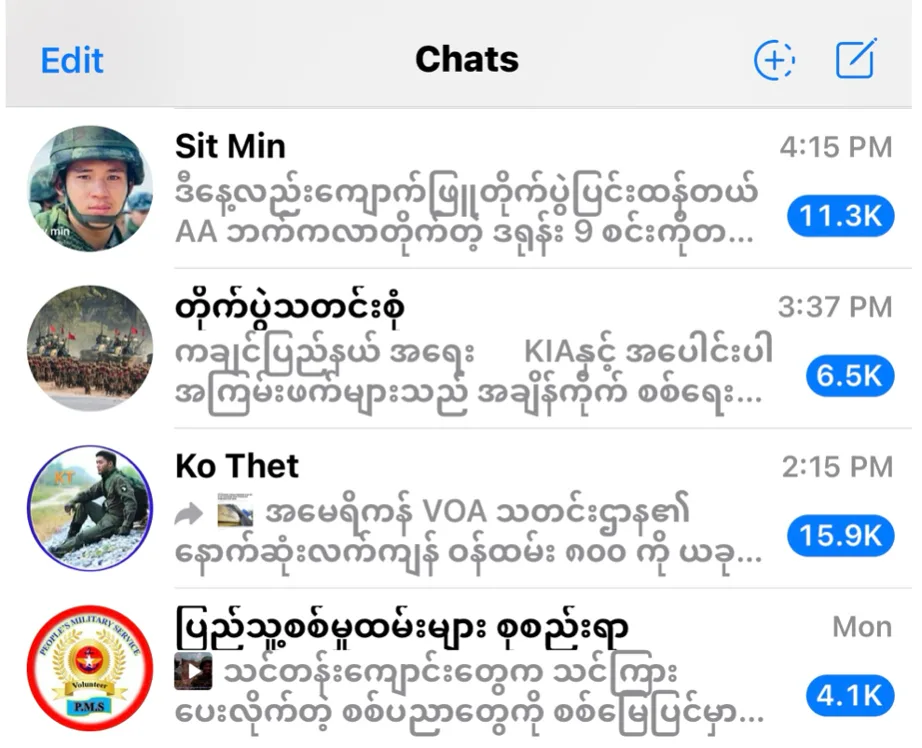
A November 2025 report by SecDev Foundation, drawing on local fieldwork and extensive content analysis of the above-mentioned Telegram channels, concluded that harmful posts on these channels are designed not to persuade but to intimidate, normalize brutality and signal impunity. Women activists are disproportionately targeted, subjected to sexualized harassment and the public exposure of personal information. Online abuse consistently translates into real-world consequences, including arrests, violence, and documented psychological trauma. In this environment, as the report starkly observed, such posts are not merely harmful; they can be deadly.
The Myanmar Internet Project documented at least 13 individuals arrested for online expression between November 2025 and January 2026 alone, a period that overlapped with the junta’s staged election process, during which digital surveillance was deliberately intensified. Among those arrested were individuals prosecuted under laws ostensibly designed to protect elections but used in practice to silence anyone who dared to question the vote’s legitimacy.
The architecture of a digital dictatorship
The visible propaganda on TikTok and the explicit intimidation on Telegram rest upon a deeper infrastructure of surveillance and legal coercion that the junta has spent five years constructing and has now fully activated.
Cybersecurity Law No. 1/2025, enacted on 1 January 2025 and brought fully into force on 30 July 2025, is the legal capstone of this system. The law mandates that any digital platform with more than 100,000 users in Myanmar retain detailed user data, including full activity logs, for up to three years and provide the regime with unrestricted access on demand. It criminalizes the use of VPNs, the primary tool citizens have relied on to access independent information and authorizes arbitrary shutdowns of online services and the seizure of digital infrastructure. Critically, its provisions apply extraterritorially: Myanmar citizens living abroad can be prosecuted for online activity the junta deems impermissible, a provision already being used to target diaspora activists in Thailand and beyond.
Beneath the law sits an AI-powered surveillance system built with technology from China, Russia, and India. Facial recognition CCTV cameras supplied by Dahua, Huawei, and Hikvision are deployed across Yangon and Mandalay, with footage cross-referenced in real time against national ID databases via an AI-powered Person Scrutinization and Monitoring System. In September 2025, this system was used in Nyaung Oo Township to identify and arrest members of the Civil Disobedience Movement, including nurses and teachers on a religious pilgrimage, by running hotel guest lists against the database. The digital and physical are no longer separate domains of repression; they have become one.
In March 2025, the junta established an “AI-powered Legal Knowledge Dissemination Supervisory Committee,” signaling an intent to use artificial intelligence not only for surveillance but also for the automated processing of dissent at scale. Human Rights Myanmar’s November 2025 submission to the UN Special Rapporteur described the resulting system as a “digital dictatorship”: a layered architecture of AI-enabled surveillance, deep-packet inspection firewalls modeled on China’s Great Firewall, spyware, and coercive legislation, integrated into a single regime designed to govern through fear and technological dominance. According to Reporters Without Borders, Myanmar is now the world’s second-largest imprisoner of journalists after China, with 61 media workers currently detained.
Five years on: The full scale of the crisis
The humanitarian toll continues to mount. According to the Assistance Association for Political Prisoners, the military has killed at least 7,761 people since February 2021, including 1,005 children, and arrested more than 30,426 people for political reasons. The UN documents that more than 12 million people now face acute hunger as a result of humanitarian blockages, foreign aid cuts, and economic collapse. Myanmar’s economy has lost nearly $100 billion since the coup, with GDP not expected to return to pre-pandemic levels for years.
Violence escalated sharply throughout 2025 as the junta prepared its phased elections, held between December 2025 and January 2026. During the election period alone, open sources documented 408 military airstrikes that killed at least 170 civilians. A junta airstrike on a school in Sagaing Region on 12 May 2025 killed 22 children and two teachers. A military paramotor attack on a Buddhist festival in Sagaing on 6 October 2025 killed at least 24 people, including three children. More than 135 paramotor attacks have been documented since December 2024. The elections were condemned by the UN, ASEAN parliamentarians, and international democracy monitors as neither free nor fair because they were conducted amid mass displacement, the exclusion of all major political parties that won mandates in 2020, and documented voter intimidation at polling sites across the country.
Throughout this period, the digital propaganda machine operated without pause. Pro-military TikTok influencers promoted the elections as a pathway to normalization, with backing from China and Russia. The junta continued operating MTube, its YouTube imitation, and promoting domestic social media alternatives as part of a longer-term ambition to build a sovereign digital infrastructure insulated from international platform policies, following the models established by Beijing’s Great Firewall model of state-controlled internet architecture and Moscow’s sovereign internet law, both of which the junta has already begun replicating through Chinese-supplied censorship technology and its own 2025 Cybersecurity Law.
A warning the world cannot ignore
Myanmar’s experience should alarm anyone who cares about the future of democratic governance. Multiple researchers and human rights organizations now describe the country as a testing ground for digital authoritarianism, a place where methods developed and refined over five years are not only available for export but are already being exported. The level of digital repression Myanmar has endured is now more comparable to China or Russia than to any of its Southeast Asian neighbors. Authoritarian governments elsewhere are watching and taking notes.
If dancing soldiers on TikTok become accepted as ordinary entertainment, digital authoritarianism will have achieved its most ambitious goal: making itself invisible. Platform companies that profit from operation in Myanmar bear direct responsibility. Technology companies must urgently invest in Burmese-language content moderation, audit how pro-military creators monetize harmful content, cooperate with local digital rights organizations, and close the loopholes that allow state propagandists to reach mass audiences without consequences.
International institutions must move beyond statements. Targeted sanctions against entities supplying the junta with surveillance technology, sustained diplomatic pressure on platform companies, and long-term support for independent Burmese media are all concrete and achievable steps. Civil society (both inside Myanmar and across the diaspora) must be resourced to build digital literacy and resilience, because those who live within this system understand it best and are already resisting it at enormous personal cost.
Five years on, Myanmar’s story is the canary in the coal mine of global digital rights. The question is no longer whether this model can spread; it already has. The question is whether the world will act before it becomes the norm.
The research supporting this piece was partly sponsored by the Central European University Foundation of Budapest (CEUBPF). The views expressed here are those of the author and do not necessarily reflect those of CEUBPF.
This op-ed draws on research and reporting from Progressive Voice Myanmar, the Myanmar Internet Project, Human Rights Watch World Report 2026, Amnesty International, Access Now, Human Rights Myanmar (UN submission, November 2025), SecDev Foundation, EngageMedia, TechPolicy.Press, the UN Office of the High Commissioner for Human Rights, the Assistance Association for Political Prisoners, Reporters Without Borders, Doublethink Lab, the East Asia Forum, International IDEA, and ACLED.