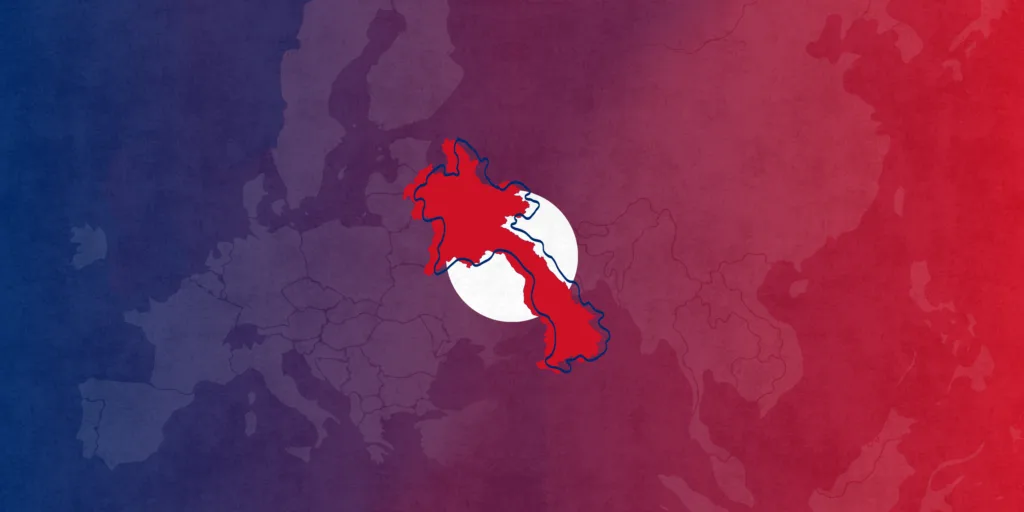
Saleumxay Kommasith’s elevation to prime minister is unlikely to change Laos’ strategic alignment with China and Vietnam, but it puts one of the country’s most internationally experienced politicians in charge. For Europe, his appointment could create new opportunities to deepen trade, investment and diplomatic ties as Laos prepares to graduate from Least Developed Country (LDC) status.
Key takeaways:
-
Saleumxay Kommasith’s elevation to the position of prime minister is unlikely to alter Laos’ strategic alignment with China and Vietnam, but it puts one of the country’s most internationally experienced and diplomatically minded politicians in charge of government.
-
His appointment comes as Laos prepares for its LDC graduation, making trade, investment and economic reform increasingly important elements of relations with the European Union.
-
For Europe, the opportunity is not to compete strategically with China but to offer Laos greater economic diversification, investment and international engagement.
On October 5, Laos’ National Assembly, its parliament, unanimously approved a rare mid-term leadership reshuffle. Prime Minister Sonexay Siphandone was moved to become president of the National Assembly (seemingly a demotion), while Saleumxay Kommasith, previously standing deputy prime minister and foreign minister, became the country’s new prime minister. In 2024, I predicted that Saleumxay would one day become prime minister. At the time, a well-placed source described him as “a safe pair of hands: skilled in diplomacy, very discreet, smooth, urbane, cosmopolitan.”
That description is useful today. Saleumxay’s appointment does not signal any significant reorientation of Lao foreign policy, nor does it mean Vientiane is about to distance itself from China or Vietnam. But personalities do matter, particularly in such a small and personalized political system. And for Europe, having perhaps the most internationally experienced, outward-looking and diplomatically minded member of the Lao leadership running the government isn’t bad news.
The way the party works
A little background first. Compared with some other communist systems, elite politics in Laos is especially dynastic. The top ranks have traditionally been filled by members of revolutionary families, notably the Phomvihanes and Siphandones, whose patriarchs led the Pathet Lao in its revolution. Longstanding geographical networks also matter, often loosely described as northern and southern factions, although institutional or policy factionalism is far more common inside the Communist Party of Vietnam. Leadership changes are normally painstakingly choreographed around the ruling Lao People’s Revolutionary Party’s (LPRP) quinquennial National Congresses, when delegates from across the country gather in the capital to approve the party’s new five-year plans and major committee members. That is what makes the events of 2026 unusual.
One unexpected transfer of power already occurred in late 2022, when Prime Minister Phankham Viphavanh resigned less than two years after taking office. Phankham officially cited his health and the difficulty of continuing in the job. Rumor had it that he was bogged down in a series of personal scandals. His departure came as Laos was struggling with the COVID-19 pandemic and a major economic crisis, with a plunging currency and inflation approaching 40%.
Sonexay, the son of former revolutionary leader Khamtai Siphandone, consequently became prime minister, probably earlier in his political career than envisaged. He inherited an unenviable situation. However, conditions have gradually stabilized, and Sonexay’s government began major restructuring of the party-state bureaucracy and sought to impose greater administrative discipline.
At its 12th National Congress in January this year, the LPRP opted overwhelmingly for continuity. Thongloun Sisoulith was re-elected party general secretary and state president; Sonexay remained prime minister; and Xaysomphone Phomvihane remained National Assembly president. The new 13-member Politburo also retained Saleumxay, although only eighth in the formal ranking.
A surprisingly disruptive year
A few months on, it’s now all change. The catalyst appears to have been the death in early August of Xaysomphone, aged 70. The son of revolutionary leader and former prime minister Kaysone Phomvihane, Xaysomphone had been one of the most senior members of the current leadership and was widely regarded as a possible future party chief and state president. If the party had simply wanted to remove Sonexay as prime minister or elevate Saleumxay, the obvious opportunity would have been the January congress. Xaysomphone’s unexpected death appears to have forced an early reopening of a leadership settlement meant to last for five years.
In November 2024, Saleumxay had been replaced as foreign minister by Thongsavanh Phomvihane, Xaysomphone’s brother. At the time, it looked like something of a demotion. “It is likely fair to view this as a (possibly temporary) demotion for Saleumxay and as the consolidation of the Phomvihane clan in senior leadership roles,” wrote Laos specialist Keith Barney in his 2024 review. He added:
“The Australian- and Russian-educated Saleumxay was broadly viewed as performing well in the role of foreign minister, having joined the Politburo in the 2021 Party Congress. But Thongsavanh offers closer relations with China, and deep access into the elite LPRP machinery. The move could also signal that Laos is positioning its inner party officials onto the China bilateral relationship, which makes sense given the debt situation.”
Saleumxay doesn’t carry one of Laos’ most famous political surnames, but he’s hardly an outsider. His father was a close confidant of revolutionary hero Choummaly Sayasone, while his younger brother, Malaithong Kommasith, is the minister of industry and commerce. Just as importantly, Saleumxay comes from Houaphanh, the northeastern revolutionary heartland from which Thongloun also originates.
Thongloun has long been regarded as Saleumxay’s political mentor. The two share obvious similarities. Both climbed through the foreign ministry. Both became foreign minister before reaching the prime ministership. Both cultivated reputations as relatively personable, technocratic and internationally minded figures within an otherwise rigid party-state. When Thongloun became prime minister in 2016, he boldly declared a retreat from Laos’ “battery of Asia” economic model and promised a major anti-corruption campaign, two policies that the party-state seemingly killed off.
Saleumxay the technocrat
Saleumxay’s career has been particularly international. He studied international relations in Moscow before completing a master’s degree at Monash University in Australia in 1997, becoming the university’s first Lao graduate. He later headed the foreign ministry’s Department of International Organizations, served as Laos’ permanent representative to the United Nations in 2012-2013 and became foreign minister in 2016. He speaks English, Russian and French.
His standing rose noticeably during Laos’ chairmanship of ASEAN in 2024. He played a central role in managing what was a diplomatically demanding year for one of the bloc’s least well-resourced members. He also represented Laos at the ASEAN-EU ministerial meeting and EU Indo-Pacific Ministerial Forum in Brussels that year. Although suspicions remain that he was removed as foreign minister in 2024 to make way for a more pro-China candidate, as noted above, he appears comfortable dealing with Beijing. In September, he led the Lao delegation to the Belt and Road Summit in Hong Kong, where he praised the initiative and sought more investment in connectivity and sustainable development. Months earlier, he visited Beijing, formally as Thongloun’s special envoy, to meet with Chinese President Xi Jinping.
Saleumxay should not be mistaken for a “Western-leaning” politician. That category doesn’t make sense in Lao politics. Nor should his promotion be expected to produce any substantial change in foreign policy. Laos remains a tightly controlled one-party state in which the Politburo and Central Committee collectively determine strategic direction. Unlike the Chinese Communist Party (CCP) and the Communist Party of Vietnam (CPV), the LPRP has not moved towards more personalist-style leadership as seen with Xi Jinping in China or party leaders Nguyen Phu Trong and To Lam in Vietnam.
Structurally, Laos remains dependent on its nearest neighbors, China, Vietnam and Thailand. China is its largest creditor and increasingly important security partner; Vietnam retains deep political, party and defense ties. Thailand is a major trading partner. Lacking large, low-cost manufacturing sectors that export goods to the West, as in Myanmar and Cambodia, Laos has had little incentive to engage meaningfully with the United States or the EU. This has led many analysts to view Laos as beholden to (and forced to hedge between) Vietnam and China, with the latter accused of luring Vientiane into a “debt trap.”
Only days before Saleumxay became prime minister, China and Laos formally opened a Joint Support and Training Center and aviation academy at Ban Keun Airport, around 50 kilometers north of Vientiane. Beijing says the jointly operated facility is intended to train Lao air force pilots and is “not directed against any third party.” Some analysts have questioned whether it could develop into a more permanent Chinese military foothold. Coming after years of controversy over China’s access to Cambodia’s Ream Naval Base, the facility will likely place Laos more squarely within debates over US-China (and Vietnam-China) strategic competition in mainland Southeast Asia.
Nonetheless, personnel matter at the margins. The prime ministership gives Saleumxay far greater influence over economic policy, investment and implementation across government. Unusually, Laos’ two most important executive positions (party chief and state president Thongloun and prime minister Saleumxay) are now held by former foreign ministers. Perhaps this says something about how internationalized policymaking in Laos has become.
What does it mean for Europe?
For Europe, Saleumxay’s elevation can be read as a positive development. EU-Laos relations have become noticeably more active over the past two years, with the two sides marking 50 years of diplomatic relations last year. European cooperation has also increasingly shifted from conventional development aid towards trade, investment, connectivity and the green transition.
Under Global Gateway, the EU, France, Germany and European financial institutions are backing programs intended to improve agricultural and forestry supply chains, responsible investment and transport links. European financing is also supporting the rehabilitation of National Road 2, an important corridor linking Thailand, Laos and Vietnam. In January 2025, Brussels announced another €45 million for cooperation between 2025 and 2027. The broader Team Europe strategy had already committed an estimated €600 million to support Laos’ previous five-year development plan.
Political engagement has also increased. European parliamentarians visited Laos in May for the first EU-Laos inter-parliamentary meeting since 2017. Annual human-rights talks have continued, including discussions over freedom of expression and assembly, civil society, the death penalty and individual cases of concern.
Laos is scheduled to graduate from the United Nations Least Developed Country status in November, which starts the clock on the loss of some trade privileges, most importantly the EU’s Everything But Arms scheme, which gives Lao exports duty-free and quota-free access to European markets. Laos will still be able to enjoy a transitional period until the end of 2029. After that, Lao exporters could face higher tariffs and tougher rules. While Vientiane will most likely be able to successfully apply for preferential trade under the Generalized Scheme of Preferences Plus (GSP+), which offers reduced or zero tariffs for vulnerable developing countries, it will need greater communication.
Saleumxay is probably better placed than most senior Lao politicians to understand what the Europeans are asking for, and perhaps more comfortable navigating the political compromises needed to secure a deeper economic relationship. On issues such as human rights and political liberalization, he’ll be as hardnosed as any apparatchik in Vientiane, since these issues are rooted in regime-security concerns. Yet his administration may be more receptive to appeals for greater trade and economic liberalization, the sort that many foreign (including European) companies have been calling for years, particularly over opaque regulation, cumbersome investment procedures, taxation and the uneven application of commercial law. European officials may now find a prime minister who speaks their language more comfortably.