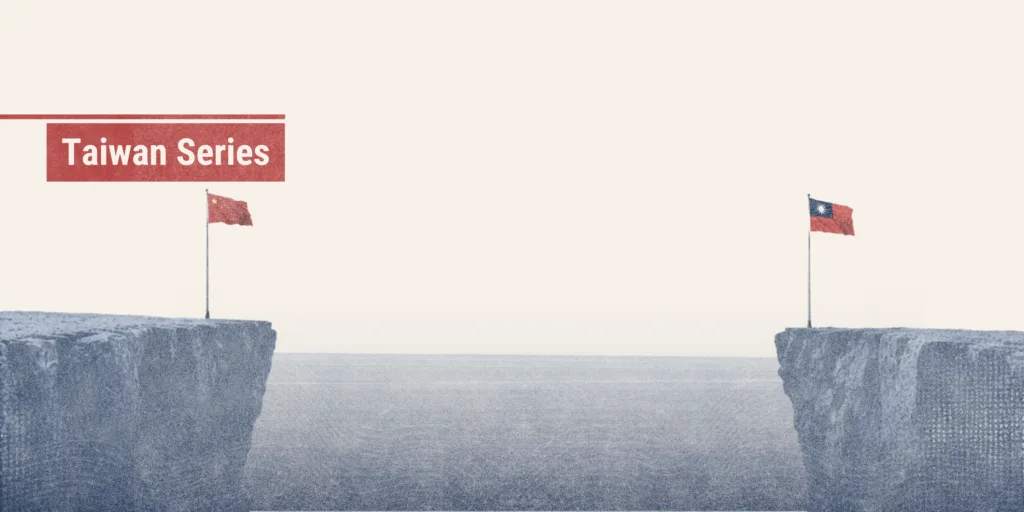
As official dialogue between Beijing and Taipei remains frozen, rhetorical rebuffs and military exercises have become a dangerous new form of communication. This context can be conceptualized as a strategic “game”, with the classical “Game of Chicken” and “Prisoner’s Dilemma” serving as two possible models. Because each game involves different incentives and strategic calculations, understanding which ‘game’ is being played may be a matter of war and peace.
Key takeaways:
-
Cross-Strait relations have shifted from a (sort-of) official dialogue during the 2008-2016 KMT-era to a new language characterized by military signaling and rhetorical brinkmanship.
-
The danger of conflict increasingly stems from situational misperception, where each side interprets the strategic “game” differently.
-
While the saber-rattling may appear irrational at first, it can function as a “madman” signal of resolve within a game-theoretic logic. However, in the absence of a dialogue, the risk of a tragic miscalculation remains dangerously high.
When US House Speaker Nancy Pelosi visited Taipei in August 2022, the world watched as Beijing responded with unprecedented military encirclement of Taiwan as soon as Pelosi left the island. What appeared at the time to be a momentary crisis has since evolved into a “new normal”: China’s high-intensity military exercises, missile demonstrations, and routine incursions across the median line in the Taiwan Strait have effectively rewritten the rules of engagement between Beijing and Taipei.
These maneuvers are not merely displays of force. In the absence of functioning official channels, military pressure and rhetorical resolve have become the primary means of communication between the two sides of the Taiwan Strait.
The end of ambiguity
For decades, the “1992 Consensus”—the informal understanding that both sides of the Taiwan Strait acknowledge “One-China” while maintaining their own interpretations—provided a strategic buffer, reducing friction between Beijing and Taipei. However, this ambiguity has significantly eroded over recent years. Since 2016, Taiwan’s leadership under the Democratic Progressive Party (DPP) has adopted a more cautious stance toward China, while Beijing under President Xi Jinping has narrowed the “consensus” to effectively mean reunification on Beijing’s terms, leaving no room for alternative views. Since Beijing refuses to engage with the DPP unless it recognizes the “1992 Consensus”, the result is a communication vacuum between the two sides.
With official dialogue at a complete standstill, both sides have been forced into a long strategic game played amid growing asymmetry and intense uncertainty, and influenced by complicated domestic politics and historical legacies.
Game theory and brinkmanship
To understand this dynamic, we can turn to game theory, specifically the “Game of Chicken” and the “Prisoner’s Dilemma”.
In the classic Game of Chicken, two “players” drive toward each other; the one who “swerves” loses and becomes the “chicken,” while the other wins and is the “hero”. Obviously, if neither swerves, the result is a catastrophic collision, the worst outcome for both sides. The game incentivizes players to signal resolve to force the other side to back down and avoid the worst outcome—the more credible signaling, the better.

In the “Prisoner’s Dilemma”, two players—typically portrayed as thieves caught by the police— are interrogated separately. If player A defects and provides evidence incriminating player B (who cooperates by remaining silent), the defector walks free while the other thief stays in prison for an extended period. Because the game’s structure incentivizes both players to defect, each has a strong reason to betray the other. As a result, the two thieves often end up giving evidence against one another, leading to longer prison sentences than if they had remained silent.

The strategic dilemma in the Taiwan Strait emerges when the two sides interpret the situation through different strategic lenses. Beijing’s military signaling often resembles the logic of the Game of Chicken, where demonstrating resolve is intended to force the opponent to back down. Taiwan, however, may interpret Beijing’s actions as evidence that cooperation is impossible, pushing the situation closer to the logic of the Prisoner’s Dilemma. When actors believe they are playing different games, their strategies can become dangerously misaligned.
One way actors attempt to impose their preferred strategic logic on an opponent is through brinkmanship, a concept popularized by Nobel laureate Thomas Schelling and a tactic used during the Cold War. It is the art of winning a game by incrementally moving closer to the cliff’s edge to demonstrate one’s willingness to risk catastrophe (pushing the situation to the “brink” of disaster) and force the opponent to concede. It is the “Madman Theory” in action: acting irrationally to signal resolve. For China, this can mean firm military responses even to relatively minor political signals from Taiwan. For Taiwan, it may involve not budging under such pressure, coupled with clear rhetorical assertions of its political identity and investment in defense modernization.
The trap of misperception
The true peril lies in “situational misperception”. If one side of the Taiwan Strait plays the Game of Chicken (using brinkmanship to force the other to “swerve”) but the opponent interprets the situation as the Prisoners’ Dilemma (where cooperation seems unavailable), both sides are incentivized to “go straight”. In such a scenario, escalation becomes highly likely, and war becomes a tragic, unintended outcome.
In other words, if China plays the Game of Chicken, it will seek to demonstrate as much resolve as possible to force Taiwan to back down. In this logic, the opponent may indeed yield when confronted with clear determination and a willingness to risk escalation to avoid catastrophe.
However, if the Taiwanese government interprets the situation through the lens of the Prisoner’s Dilemma and perceives the PRC as unwilling to cooperate, the incentives shift. Under this logic, Taiwan is encouraged not to cooperate, either to avoid the worst possible outcome or to attempt to cooperate while the other side defects.
What’s next
There is no definitive answer as to which game is currently being played in the Taiwan Strait. However, the increasing resolve of China under Xi does resemble the Game of Chicken. On the other side of the Strait, longitudinal surveys suggest a strong willingness among Taiwanese citizens to resist military coercion “at all costs,” a stance consistent with the logic of the Prisoner’s Dilemma, with roughly 70% expressing willingness to fight if the PRC initiates an attack. Obviously, this strategic positioning is taking place in the context of a massive, and arguably growing, asymmetry between Taiwan and the PRC. Adjusting the games to different paybacks for the two actors could further distance their approaches.
Yet there are flickers of hope that engagement can still change the trajectory. A 2024 visit to Taiwan led by Tsinghua University found that 10% of Chinese student respondents changed their minds about supporting the use of force after directly engaging with their peers on the other side of the Strait.
Engagement can alter strategic expectations and shift the logic of the game itself. But until the silence of the Strait is broken by something more than the roar of fighter jets, the region remains trapped in a dangerous game where the margin for error is thinning every day.
The production of the article was funded by the EU NextGenerationEU through the Recovery and Resilience Plan for Slovakia under the project No. 09I03-03-V04-00595”.