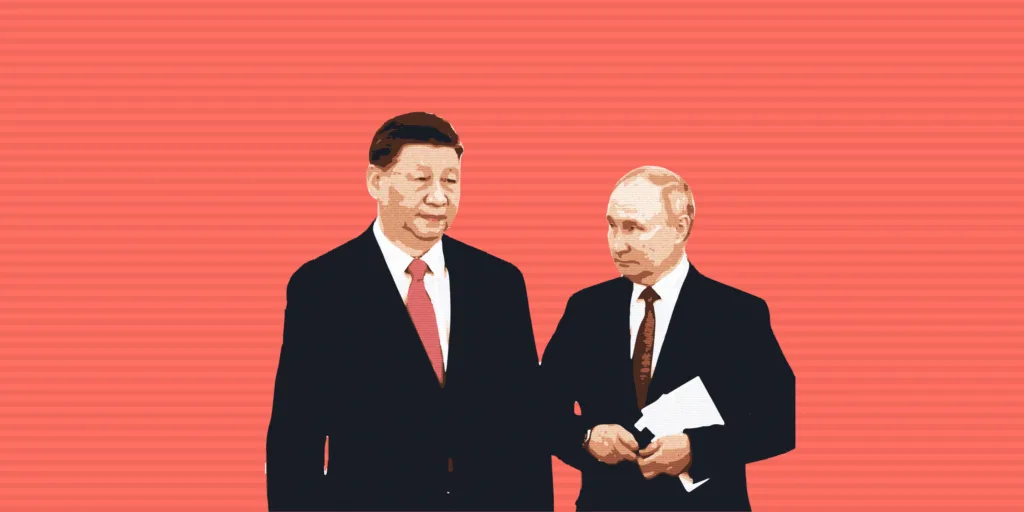
Putin’s latest visit to China was both ceremonial and routine. While nothing occurred during the visit that might suggest a crisis in bilateral relations, the “partnership without limits” is not without its critics in Russia.
Key takeaways:
-
The Russian political elite is aware of Russia’s deepening existential dependence on China, especially when it comes to the ability to continue war against Ukraine and maintain access to modern technologies.
-
The asymmetrical relationship with China is becoming a target for criticism by certain parts of the Putin regime. However, in the current situation, Putin is forced to “lean on one side,” even as he bears the political costs of dependence on China.
-
For China, Russia is one of the key elements in managing its confrontation with the US, which is why Beijing will seek to promote Russia’s further political, economic, and cultural decoupling from the West.
Less than a week after US President Donald Trump’s visit, Russian President Vladimir Putin arrived in Beijing. Although Xi Jinping, China’s president, gave the Russian leader the red carpet treatment, Putin left China without the main prize: approval for the construction of the Power of Siberia 2 gas pipeline. At the same time, some Russian observers noted symbolic signals indicating that Putin and Moscow’s position in the partnership with China are becoming increasingly subordinate.
Indeed, some recent statements of Russian officials suggest that the partnership with Beijing is becoming a source of frustration for the Kremlin and a cause of intensifying tensions within Putin’s regime. Russia is not blind to its growing dependence on China. The Russian war effort would not be possible without China’s support, which backs the Kremlin diplomatically, economically, and militarily, while simultaneously trying to maintain the appearance of neutrality.
Russia must pay dearly for China’s lifeline. Putin accepts this deep (inter)dependence, recognizing that, unlike the West, Beijing does not pose a normative threat to Russia—just as the Golden Horde did not threaten its values and culture, as Putin, always keeping on digging deep into Russia’s history, once recounted.
“Leaning to one side”
Putin’s visit to China demonstrated the further consolidation of a “strategic partnership” defined primarily by shared strategic goals and “brotherhood in arms,” as well as by hard economic interests. A detailed and lengthy joint declaration on deepening strategic coordination certifies that, despite growing asymmetries and existing tensions, including Russia’s efforts to curb imports of Chinese cars through “recycling fees,” China and Russia have been strengthening their partnership to mitigate external shocks and sanctions, such as developing alternative payment systems. The Sino-Russian partnership increasingly produces a system of interconnected vessels across two countries in the economy, energy, transport, military, currency, culture, education, media, etc., which runs parallel to that of the West and is ultimately aimed at building resilience against Western economic, political, and ‘civilizational’ pressure.
The second major declaration, signed during the summit, advocates multipolarity and a new type of international relations, confirming that the partnership is based on opposing US hegemony and, as China and Russia portray it, the West’s neocolonial ambitions, and on upholding the principle of indivisible security. In other words, the driving force behind the cooperation is securing the right to maintain special spheres of influence in their respective neighborhoods, as well as the stability of both regimes.
China has, since the start of Russia’s full-scale war against Ukraine, been parroting the Kremlin’s arguments regarding the need to eliminate the “root causes” of the “Ukrainian crisis” and Russia’s legitimate right to shape the security architecture in Europe. Chinese diplomats and experts demonstrate a strong alignment with Russia’s geopolitical aims.
While this does not translate into China’s official recognition of Russia’s territorial annexation, Beijing has been expanding its economic and infrastructural presence in the Russian-annexed Donetsk and Luhansk regions and, at least tacitly, has accepted the quasi-diplomatic cooperation between Chinese local authorities and these regions.
Growing domestic discontent over Russia’s reliance on China
While Russia increasingly needs China’s support, Beijing often plays hardball. Putin would certainly welcome more concrete results from his visit, other than ritualistic rhetoric from China. Putin and Xi failed to reach an agreement on the Power of Siberia 2 gas pipeline, a key issue for Russia. The Kremlin is pushing another gas project with a stubbornness worthy of a better cause, one that would compensate for the loss of the European market.
Although China needs additional gas supplies, the disruption caused by the war in the Middle East has not yet tipped the balance in discussions regarding the viability of long-term reliance on Russian sources. Notably, just as the Russian proposal on the gas pipeline was, at least temporarily, rebuffed, tankers shipping American gas were, for the first time in over a year, leaving the United States directly for China. While pipeline imports from Central Asia and Russia are cheaper and will likely remain a preferred source for China, the resumption of direct LNG imports from the US appears to be a symbolic sign of some thaw in energy and trade disputes between Beijing and Washington.
In 2026, the signs of “war fatigue” are increasingly evident in Russia, among both the general public and members of the Kremlin elite. A telling symbol of the sense of threat and isolation was the Victory Day parade on May 9. The most important event in Russia’s political calendar took place under the shadow of the threat of a Ukrainian airstrike, with a small number of foreign delegations, notably the absence of an official Chinese delegation.
On the eve of Putin’s visit to China, Russia Today published an article by Alexey Martynov, an influential pro-Kremlin commentator, under a telling title, “Beijing can no longer treat Moscow as a junior partner.” Although, in his view, Russia and China are moving toward a “structural alliance that is reshaping the global balance of power,” he laments that while Moscow has largely accepted the logic of deep strategic interdependence, China seeks only to reap the benefits of the partnership while minimizing its own commitments. Therefore, Martynov warns, “at some point, Beijing will have to decide whether it truly views Russia as an equal strategic partner or merely as a useful resource base.”
Specific concerns are also openly voiced by representatives of the Russian industrial complex. Deputy Prime Minister for Industry Denis Manturov stated that the Chinese automotive industry should not compete with AvtoVAZ, a Russian state-owned carmaker, and should offer only premium vehicles, including electric and hybrid cars. Russian technocrats are sharply divided regarding cooperation with China. While Rostec is reluctant to see China’s presence in the Russian automotive market (it controls AvtoVAZ and KamAZ), the energy sector, led by Rosneft and Gazprom, supports deepening cooperation with China. Rosneft CEO Igor Sechin promotes the idea of Russia becoming a resource base for China, with Russian energy resources helping China achieve its strategic goals.
Another sign of growing frustration with Russia’s position vis-à-vis China is the statement by Yuri Trutnev, the Russian president’s representative in the Far Eastern Federal District, who said during the Harbin Expo in May that he was “a little annoyed” by the PRC’s technological dominance. He lamented that during the fair, China showcased AI solutions, unmanned aerial vehicles, and robotics, while Russia could only present nature’s bounty: “honey and crabs.” Trutnev also made it clear that infrastructure development in Russia’s Far East primarily supports Chinese companies exploiting Russian natural resources, and that without Chinese investors, the region “would not be able to develop.” Indeed, the problem of technological dependence on China is a serious concern for the Kremlin. Russia is unable to exploit Arctic deposits on its own without Chinese support. The price for this ‘brotherly assistance’ is the opening of the way for China to achieve Arctic state status.
Although internal criticism of Russia’s unequal partnership with China has not been uncommon, it has never been as vocal as it was during Putin’s visit to China. While this does not appear to be a coordinated effort, criticism has come from across the elite spectrum: regional authorities, industry representatives, and opinion leaders alike. These statements reject the idea of Russia becoming a raw-materials appendage of China, but avoid direct criticism of Putin, who has been the architect of the pivot to the East since 2014. Importantly, the criticism was not limited to Telegram; it was also circulated by state-controlled media. This may be interpreted either as an indirect dialogue among representatives of various factions of the ruling elite or as an act of ‘acceptable’ disobedience aimed at altering Putin’s policy toward China. In fact, separate Kremlin factions are said to either support, in particular the energy sector, or sabotage the model of cooperation with China.
China and Putin’s “Long State”
Although Russia’s leader finds himself in the most difficult position since February 2022, Beijing is not investing more in his regime than is necessary to keep him in power, sustain the partnership and ensure that Russia does not lose the war with Ukraine. Even after Putin, authoritarianism and revisionism are unlikely to disappear from Russian political life, namely the factors that are pushing Moscow into Beijing’s embrace. In 2019, Vladislav Surkov published an article titled “Putin’s Long State.” He argued that Russia’s current political model, crafted by Putin, ensures the survival of the state and the development of the Russian nation in the decades to come and, as such, is ultimately destined to outlast Putin himself. However, Putin’s recent visit to China suggests the Russian leader may be remembered as the one who once again symbolically accepted a yarlyk (a symbol of the subordination of the Ruthenian rulers to the Golden Horde) from the Eastern power.
This subordination is increasingly structural rather than merely personal. Although the Sino-Russian partnership has been grounded in relational diplomacy between heads of state (yuanshou waijiao), as evidenced in the declaration adopted by Xi and Putin during the May summit, it is increasingly being entangled by the network of contacts at the level of parliaments, regions, political parties, the military (under the 1996 confidence-building mechanism), universities and media outlets. In the face of Western ostracism, the Russian elite reoriented itself structurally toward China, which, however, does not preclude the criticism of the “unequal friendship.” As a result, an ever-expanding network of people-to-people connections has been cementing Russia’s isolation from the West. China, in short, can have Russia even without Putin.