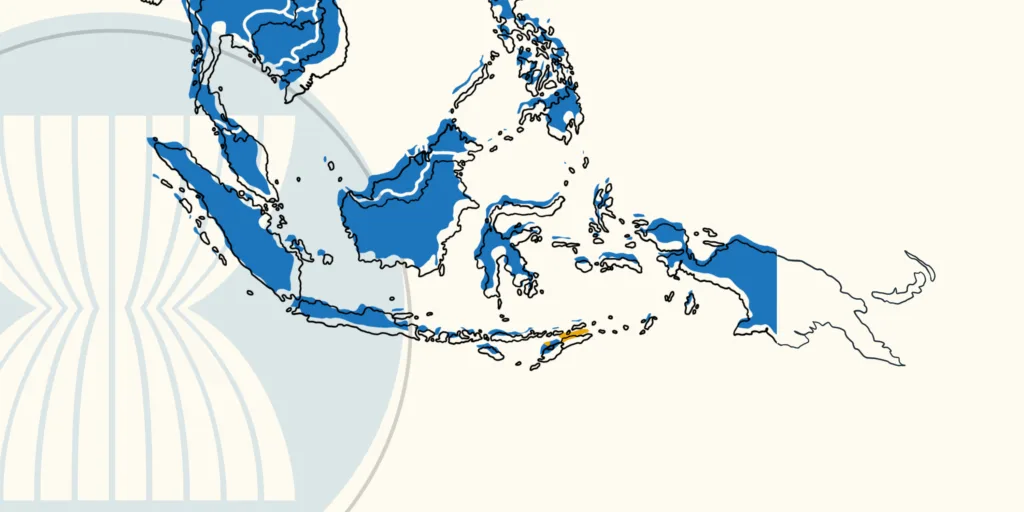
With Timor-Leste’s admission to ASEAN in October 2025, the vision of the association’s founding fathers has been fulfilled: all Southeast Asian nations are now united within a single regional institution.
Key takeaways:
-
Timor-Leste’s accession to ASEAN in 2025 was a significant milestone for a small, post-conflict nation and the poorest country in Southeast Asia.
-
To strengthen its economy, Dili must diversify beyond oil and modernize its agricultural sector. Decades of overreliance on resource extraction have left other sectors underdeveloped, and with the Petroleum Fund rapidly depleting, time is running out.
-
The country’s pragmatic approach to relations with the United States and China mirrors ASEAN’s broader strategy of hedging between major powers.
-
Timor-Leste’s accession provides an opportunity for ASEAN to become a stronger advocate for democracy and human rights, particularly in Myanmar.
Since gaining independence in 2002, Timor-Leste has regarded ASEAN membership as a crucial milestone in its nation-building process and in defining its regional identity. “It seems like the road to heaven is easier than to reach the gates of ASEAN”, said President José Ramos-Horta in 2023.
The path taken by Southeast Asia’s youngest nation has certainly been difficult. Timor-Leste has had to undertake extensive domestic political and economic reforms while contending with the lasting consequences of Portuguese colonialism and then Indonesian occupation from 1975 to 1999.
ASEAN membership as a motivation for domestic reforms
ASEAN membership has long been viewed as both an incentive for necessary domestic reforms and an opportunity to address the country’s shortcomings, including limited domestic production, shortages of skilled workers and inadequate infrastructure.
Timor-Leste’s first president, Xanana Gusmão, began engaging with ASEAN in 2005, when Dili was officially granted observer status. Facing opposition within the regional bloc, the country waited another six years before formally applying for membership. Singapore cited Timor-Leste’s underdevelopment and limited capacity to fulfill membership obligations as key reasons for delaying the process.
Dili nevertheless continued to improve its regional standing by adjusting domestic policies, establishing embassies in every ASEAN member state and ratifying the organization’s agreements.
The breakthrough came in 2022, when ASEAN leaders agreed at the 40th and 41st ASEAN summits to accept Timor-Leste’s application “in principle” and pledged to create a concrete roadmap towards full membership. The roadmap was delivered in 2023, paving the way for a step-by-step accession process that culminated in membership in 2025, despite opposition from Myanmar’s military government.
Now that it has access to ASEAN’s cooperation mechanisms, Timor-Leste has an opportunity to strengthen its long-term prospects. Much will depend, however, on Dili’s ability to improve governance, facilitate economic transformation, increase investor confidence and navigate an increasingly complex geopolitical landscape. This is a considerable challenge for a young, post-conflict nation with a population of only 1.4 million.
Economic opportunities and challenges
Looking ahead, Timor-Leste has several tangible opportunities to strengthen its economy by accessing the cooperation mechanisms of an organization representing around 680 million people and a combined GDP of more than $4 trillion.
First and foremost, ASEAN membership opens the door to the ASEAN Free Trade Area, which substantially reduces tariffs and other trade barriers between member states. Accession, therefore, provides Timor-Leste with an opportunity to diversify its economy and expand exports by increasing market access.
Should it also join the Regional Comprehensive Economic Partnership (RCEP), Dili could benefit from economic cooperation beyond ASEAN itself. RCEP includes Australia, China, Japan, South Korea and New Zealand, meaning that Timorese exporters could gain preferential access to markets accounting for around 30% of global GDP.
Greater trading opportunities could, in turn, encourage additional investment in Timor-Leste’s private sector. Cambodia’s experience suggests that ASEAN accession can have a tangible positive effect on foreign direct investment. At the time of Cambodia’s accession in 1999, FDI inflows stood at 2.9% of GDP. They have since tripled, remaining at around 8–10% of GDP in recent years.
Potential investors may perceive ASEAN membership as providing additional protection against political risk. Timor-Leste could therefore position itself as an attractive new investment destination, leveraging its geographic location and relatively low wage levels to stimulate economic growth, at least in the short term.
The benefits of ASEAN membership will not materialize automatically, however. They will require sustained efforts by the Timorese government to transform the country’s fragile economy. Its main challenges are dependence on oil, a severe trade deficit and a shortage of skilled labor.
Since independence, the country has relied heavily on oil revenues to finance state institutions and support reforms. Its main oil and gas field, Bayu-Undan, was shut down in 2025 after its reserves were depleted, leaving Dili with a difficult financial outlook.
Roughly 85% of the 2025 state budget was financed through the Petroleum Fund, an $18 billion financial safety net accumulated over years of oil and gas extraction. At the current rate of spending, the fund is expected to be exhausted within a decade, making rapid economic transformation an existential necessity.
Meanwhile, domestic industry remains underdeveloped, and the country’s trade position highlights its vulnerabilities. Limited production capacity and technological development could prevent Timor-Leste from capitalizing fully on access to new markets.
The current account deficit stands at more than 30% of GDP and remains under pressure as oil exports diminish. Coffee is the country’s largest non-oil export, but the sector has stagnated despite rising global prices. In 2022, coffee accounted for just 2.2% of GDP.
Timor-Leste also faces low levels of social development. Around 40% of the population lives below the poverty line, while nearly one in three adults lacks access to adequate education. This limits the country’s ability to develop a highly skilled workforce, despite having one of the youngest populations in the world.
With a median age of only 22, Timor-Leste’s younger generation represents considerable untapped potential. Without sufficient government support and domestic employment opportunities, however, many young Timorese may seek work in neighboring countries.
Timor-Leste’s values-based foreign policy
Timor-Leste’s accession also highlights both new opportunities for regional cooperation and potential political risks.
At the regional level, its admission signals ASEAN’s willingness to engage meaningfully with countries that remain economically less developed. Some ASEAN members had previously argued that admitting a country with limited economic and diplomatic capabilities could undermine the organization’s cohesion and slow its progress.
Timor-Leste’s admission suggests that ASEAN has moved beyond this view, recognizing its capacity to foster collective regional development rather than leaving less-developed countries behind.
Singapore, once a vocal critic of Timor-Leste’s admission, has since changed course and now supports its membership, including through bilateral assistance programs. Following ASEAN’s recognition of Timor-Leste’s membership “in principle” in 2022, Singapore launched the Singapore–Timor-Leste ASEAN Readiness Support program to train Timorese officials and ensure that the country possessed the institutional capacity to fulfill its obligations as a member.
The program has since been expanded and extended until 2028, to facilitate Dili’s smooth integration into the bloc. This combination of support and conditionality created constructive external pressure, which many Timorese politicians welcomed as a catalyst for necessary reforms.
Timor-Leste may not, however, prove to be an easy partner for ASEAN. Dili’s strong, values-based criticism of the coup in Myanmar and the subsequent quasi-civilian regime challenges ASEAN’s cautious approach, including its core principles of consensus and non-interference in member states’ domestic affairs.
In May 2026, Timor-Leste’s judiciary formally accepted a complaint and opened an investigation into alleged war crimes committed by Myanmar’s coup leader and current president, Min Aung Hlaing. In response, the Timorese chargé d’affaires in Myanmar was ordered to leave the country, signaling a deepening rift between the two governments and raising the prospect of sustained diplomatic tensions that could test ASEAN’s unity.
There are, however, positive views within ASEAN regarding Timor-Leste’s active promotion of democracy and human rights. For the European Union, Timor-Leste is emerging as one of its most like-minded partners within ASEAN. Conversely, Brussels’ values-based foreign policy is highly regarded by the bloc’s newest member.
Navigating the volatile geopolitical landscape
Questions also remain about where Timor-Leste fits within current geopolitical tensions and the wider strategic rivalry between China and the United States.
Dili’s active engagement with both powers resembles the approach taken by other ASEAN members and reflects the region’s broader strategy of balancing and hedging. It aims to maximize economic and security benefits without formally aligning with, or alienating, either side.
Western countries, particularly Australia and the United States, are among Timor-Leste’s principal security partners. Relations with China, meanwhile, have largely focused on trade, investment and infrastructure modernization.
Beijing played an important role in constructing the Suai Highway and Tibar Bay Port, both of which provide essential infrastructure for the country’s future economic development. In 2021 and 2022, China became Timor-Leste’s largest export market, although export volumes have since fallen significantly. The two countries also elevated their bilateral relationship to a Comprehensive Strategic Partnership in 2023.
Timor-Leste also maintains close relations with Australia. The two countries lie on opposite sides of the Timor Sea, which is an important patrol zone for the Royal Australian Navy’s submarine fleet. Australia has therefore long had an interest in maintaining political stability in Timor-Leste and preventing it from becoming a failed state.
Formal defense cooperation and joint military exercises have helped strengthen bilateral relations. The two countries also have the potential to jointly develop the Greater Sunrise gas fields, a project that could prove vital to Timor-Leste’s economy.
In 2018, Timor-Leste and Australia signed an agreement defining their maritime boundary and establishing a fairer revenue-sharing arrangement.
The future ahead
Moving forward, three strategic priorities could help Timor-Leste restructure its economy and establish a sustainable path towards growth.
First, it should pursue development of the Greater Sunrise gas fields with Australia to generate much-needed revenue in the short- to medium-term. Second, it should use its accumulated financial reserves and regional support to invest in domestic industries and lay the foundations for a strong non-oil export sector. Third, it should implement domestic reforms, including changes to land-ownership laws, to improve investor confidence and attract more FDI.
With the Petroleum Fund expected to be exhausted within the next decade, Timor-Leste must find alternative sources of revenue. Located in the Timor Sea, Greater Sunrise could generate between $50 billion and $70 billion in revenue, which is shared between Timor-Leste and Australia.
However, a longstanding dispute over the pipeline’s route has stalled development. Australia has favored piping the gas to Darwin in northern Australia, while Timor-Leste has insisted that it be routed to the country’s southern coast.
In the longer term, Timor-Leste must ensure that it has the capacity to escape the resource curse. The country could diversify its revenue sources by developing agriculture, investing in light manufacturing and promoting tourism.
Around 60% of Timorese citizens depend on subsistence farming, yet the government has devoted disproportionately little attention to modernizing the sector or creating concrete plans to maximize the productivity of available land and labor. With sufficient state support, there is considerable potential to improve existing agricultural practices and expand the production of high-demand crops suited to the regional climate.
Limited aviation connectivity has also long constrained Timor-Leste’s development as a tourist destination. The ongoing expansion of the country’s airport must be complemented by improvements to domestic infrastructure and targeted marketing efforts that place Timor-Leste more firmly on the international tourism map.
In recent months, the country has established several new direct flight connections, which could help attract more visitors from elsewhere in Asia and Europe.
Although agriculture and tourism offer promising avenues for economic development, their success will largely depend on Timor-Leste’s ability to attract foreign investment and expand domestic manufacturing.
The World Bank has identified land administration as a major barrier to foreign investment, citing unclear land-use rights, overlapping claims and weak enforcement mechanisms as significant gaps in the legal system. The International Monetary Fund has recommended accelerating the issuance of land titles, which could unlock private-sector lending and create a more coherent system of land ownership.
Addressing these constraints would strengthen investor confidence and open new growth opportunities across key sectors.
Timor-Leste has much to gain from ASEAN membership, but significant reforms will be required if its economy is to reach its full potential. With sound and transparent governance, Southeast Asia’s youngest nation could use ASEAN membership to accelerate growth and, over time, become a model of post-oil economic transformation.
Success will depend on the commitment and integrity of the country’s political leadership, sustained public support and the broader geopolitical and regional economic environment. The European Union should provide greater support, both in words and through concrete action, for Timor-Leste’s socioeconomic development and help strengthen a democratic voice within Southeast Asia.
Work on this article was funded by the EU NextGenerationEU through the Recovery and Resilience Plan for Slovakia under the project No. 09I03-03-V04-00462.