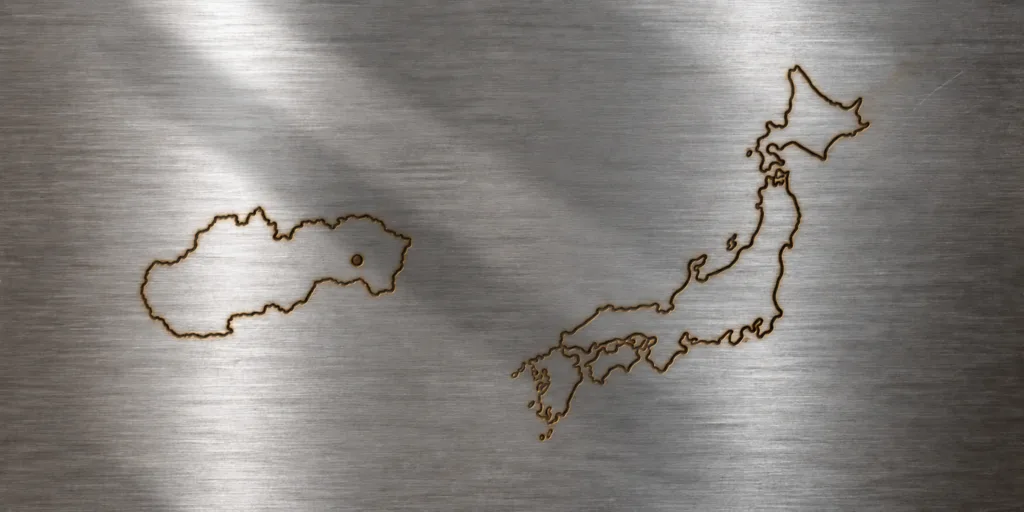
The revival of the V4+Japan format and Nippon Steel’s takeover of the Košice steelworks offer Slovakia a historic opportunity to elevate its relations with Tokyo. Whether this momentum turns into lasting cooperation will depend largely on Slovakia’s foreign policy consistency – in Brussels, on Ukraine, and towards Beijing.
Key takeaways:
-
Nippon Steel’s acquisition of US Steel and the subsequent integration of the Košice plant directly into the Japanese parent company represent the main impetus behind Tokyo’s renewed interest in Slovakia.
-
The current convergence of circumstances has created an opportunity for Slovakia to transform the present momentum into a strategic partnership with Japan. Following its current V4 presidency, Slovakia will host the Three Seas Initiative Summit in April 2027. Foreign Minister Juraj Blanár has invited Japanese Prime Minister Sanae Takaichi to attend. The summit could therefore provide an opportunity to formalize the strategic partnership.
-
For Slovakia to sustain the current positive trend and make use of the emerging opportunities to deepen relations with Japan, it must be seen as a reliable and predictable partner. This means, above all, demonstrating like-mindedness, maintaining alignment with EU positions, supporting Ukraine, and establishing and communicating a clear hierarchy of priorities in its relations with China.
On September 1, 2026, Japanese Foreign Minister Toshimitsu Motegi arrived in Slovakia for an official visit. It was the first visit by a Japanese foreign minister since 2007 and the most significant visit by a Japanese representative since then-Prime Minister Shinzo Abe visited Bratislava in 2019 for the V4+Japan summit.
Motegi similarly traveled to Slovakia to attend a meeting of the foreign ministers of the Visegrád Four and Japan: the V4+Japan format. The Central European grouping has resumed cooperation after disagreements between Poland and Hungary over policy towards Russia and Ukraine interrupted it. The V4+Japan format played an important role in developing political dialogue between the V4 countries and Japan. After 2021, cooperation lost momentum because of the COVID-19 pandemic and, following internal disagreements within the V4, it effectively came to a halt in 2023.
Ahead of the ministerial meeting itself, Motegi met with Prime Minister Róbert Fico and Minister of Foreign and European Affairs Juraj Blanár. After a relatively long period of low dynamism in bilateral relations, a new momentum is emerging that could help improve the quality of relations between Japan and Slovakia. Its success, however, will depend on several factors: Slovakia’s approach to the war in Ukraine, its role within the EU, the future of the V4, and, last but not least, its position towards developments in East Asia.
Visegrád ambivalence
Japanese and Slovak strategic foreign policy documents have long made clear that the V4+Japan format is a natural platform for developing political relations among the participating actors. From the Japanese perspective, this pragmatic approach allows Tokyo to cultivate relations with four EU member states simultaneously. During the 2010s, Japan under Shinzo Abe intensified cooperation with the V4, while the 2019 summit, the high point in the development of mutual relations, signaled an interest in further deepening this cooperation.
Nevertheless, the V4+Japan format failed to fulfill its potential, largely because of shortcomings on the Central European side, with the V4 countries unable to make sufficient use of this initiative. A second problem was the cohesion of the grouping in foreign policy – most recently, in relation to Ukraine. Japan’s position on the war in Ukraine has remained unchanged since 2022. It does not regard a conflict that violates sovereignty and territorial integrity as merely a European issue, but as a threat to the rules-based international order with major implications for East Asia. Japan has therefore provided Ukraine with substantial humanitarian, financial, and non-lethal military assistance. Japan has also shown considerable interest in Ukraine’s post-war reconstruction.
An internally divided grouping of Central European states therefore offered little appeal as a constructive political partner. As the only V4 country whose government has maintained a clearly pro-Ukrainian position since the escalation of the conflict in 2022, Poland assumed the role of Japan’s principal partner in these areas. This was reflected in political meetings and in support for linking the private sectors of both countries in preparation for Ukraine’s reconstruction.
In economic relations, the V4 is an even more complicated case. On the one hand, as EU member states with relatively inexpensive labor, these countries have long attracted, and competed for, Japanese and other foreign investment. This is why the V4 has never functioned effectively as a platform for developing economic relations. Meanwhile, a more functional ecosystem of interconnected supply chains has emerged across the V4 over the past decades. Combined with shortages of suitably qualified labor and rising labor costs in the region, cooperation built on the interconnectedness of the individual national economies appears to offer a promising path for the Central European states.
Finally, the shift in V4 dynamics brought about by Hungary’s parliamentary elections and the subsequent change of prime minister made it possible to restore the functionality of the Visegrád Group and, consequently, of the V4+Japan format. Japan’s renewed interest in restarting political dialogue through this platform is clearly good news not only for Slovakia but also for the other V4 countries. It would, however, be a mistake to concentrate all efforts on developing relations with Japan exclusively through the V4.
Japan-US deal provides a much-needed impulse
In 2025, Japanese steelmaker Nippon Steel finalized its acquisition of US Steel, an American steel giant, which includes the steelworks in Košice. In October 2026, the Košice plant will become part of Nippon Steel’s ownership structure and the basis of the group’s activities in Europe. The steel mill in eastern Slovakia is Nippon Steel’s first European acquisition. Its location and the existing infrastructure linking the plant with Ukraine amplify the move’s significance. This is also suggested by the actions of the plant’s new management. Among the first officials to arrive after the takeover were the ambassadors of Japan, Poland, and Ukraine, suggesting that steel produced in Košice could become part of supply chains linked to Ukraine’s post-war reconstruction.
The talks held during Motegi’s visit confirmed this goal. Fico identified Nippon Steel’s investment as a key area for further cooperation, together with industrial modernization and new technologies. According to the Slovak Prime Minister, the goal is to build a partnership that “will not merely be a political label, but will deliver concrete results for Slovakia, for our economy, and for our citizens.” Blanár added that both sides are already preparing a visit by the Japan External Trade Organization (JETRO) to eastern Slovakia, where it is expected to present the region’s investment potential to local stakeholders in connection with Nippon Steel. Slovakia has likewise expressed interest in a mission by the Japanese business federation Keidanren. This could gradually bring small- and medium-sized Japanese companies linked to Nippon Steel’s supply chain to Slovakia as well, representing the most realistic path to expanding Japan’s investment footprint in the country.
Capitalizing on the momentum
Motegi’s visit confirmed that there are no fundamental disputes in Slovak-Japanese relations and that both countries agree on the importance and necessity of maintaining and strengthening a free and open international order based on the rule of law. Ahead of the meeting, Blanár noted that bilateral trade reached almost one billion euros last year and described Japan as one of Slovakia’s key Asian partners. Japanese companies also employ almost 20,000 people in Slovakia.
The Slovak side also expressed interest in upgrading bilateral relations to the level of a strategic partnership, something it has pursued for some time. Motegi’s visit, along with the planned intensification of political and economic ties, represents the right approach to making such a strategic partnership more likely. Moreover, Blanár invited Japanese Prime Minister Sanae Takaichi to Bratislava for a summit and business forum of the Three Seas Initiative in April 2027, which Slovakia will chair. If the Prime Minister accepts the invitation, this would provide an excellent opportunity to elevate Slovak-Japanese relations to the level of a strategic partnership.
At the same time, it would open up a parallel multilateral platform through which Slovakia could further develop its relations with Japan. The Three Seas Initiative, of which Japan has been a strategic partner since 2024, offers a framework that is not dependent on unanimity among four Central European governments and, moreover, directly connects Slovakia with countries on the EU’s eastern flank, including Ukraine.
Responsibility and predictability
Tokyo tends to rely on direct bilateral engagement with smaller countries, especially when it can clearly identify the other country as a like-minded partner. When that certainty is absent, Japan is less inclined to invest political effort in deepening bilateral ties and instead turns to other, more reliable channels. In Slovakia’s case, this primarily means the EU. At the declaratory level, Slovakia and Japan broadly agree on the international order, the war in Ukraine, and current challenges in the Indo-Pacific. In practice, however, a gap exists between declared positions and the implementation of government policy, including on issues important to the further development of both political and economic relations with Japan.
Slovakia therefore faces not only the task of building new institutional channels, but above all the need to behave as a predictable partner. This means acting as a responsible member of the European Union that does not distance itself from common EU positions, and as a proactive and predictable neighbor of Ukraine, not only in declarations but also in voting and decision-making at the European level. To fully exploit the potential for cooperation on Ukraine’s reconstruction, it is equally important for Slovakia to act as a proactive partner that creates space for economic actors to participate in reconstruction projects.
The same applies to Slovakia’s approach to the Indo-Pacific. During his visit, Motegi communicated Japan’s positions on Indo-Pacific developments both in his meeting with Blanár and at the V4 summit, including on North Korea. In this area, the two countries largely agree, particularly on cooperation within the United Nations. Japan, however, faces other Indo-Pacific challenges, namely China’s growing assertiveness, tensions between China and Taiwan, and territorial disputes with neighboring states, including China and Russia. In this context, Slovak foreign policy plays an important role in shaping bilateral relations.
Róbert Fico’s visit to China in September 2025, on the occasion of the 80th anniversary of the end of the Second World War, provides a good example of conduct that does little to strengthen Slovak-Japanese relations. Fico was the only EU head of government to attend the military parade. The Japanese government had reportedly urged European and Asian countries not to participate in the event. Fico’s and Xi Jinping’s subsequent statements about Slovakia’s role in promoting EU-China relations, and the need to place bilateral ties on a “fast track,” were viewed negatively in Japan.
Such rhetoric may be presented as pragmatic diversification, but from Tokyo’s perspective it sends a different signal: that Bratislava does not distinguish between partners by whether they share its values, but by who offers more. Japan has long viewed China as a systemic rival and expects its regional partners to behave predictably in this regard. Slovakia does not need to terminate its relations with China, but it does need to clarify its hierarchy of priorities in East Asia and communicate them consistently.
Motegi’s visit demonstrated that a genuine opportunity for a qualitative shift in relations exists. At present, this momentum is being driven by Nippon Steel’s investment, Japan’s interest in Ukraine’s reconstruction, and Tokyo’s willingness to discuss a strategic partnership. Slovakia has roughly a year and a half before the Three Seas Initiative summit in Bratislava to turn this opportunity into reality. The condition, however, is not only greater activity towards Japan, but also discipline in foreign policy and clear, predictable behavior in Brussels, towards Kyiv, and ultimately towards Beijing. If this condition is not met, the momentum being discussed today may fade just as quickly as it emerged.
This article was supported by the project “Partnership Insights: Diagnosing Cooperation Challenges between Japan and Slovakia (PICC-JS),” project number: UGA-10-PDS-2024, funded by University grant agency of Matej Bel University. The funding body had no role in the research design, data analysis, interpretation of the findings, or preparation of the manuscript.