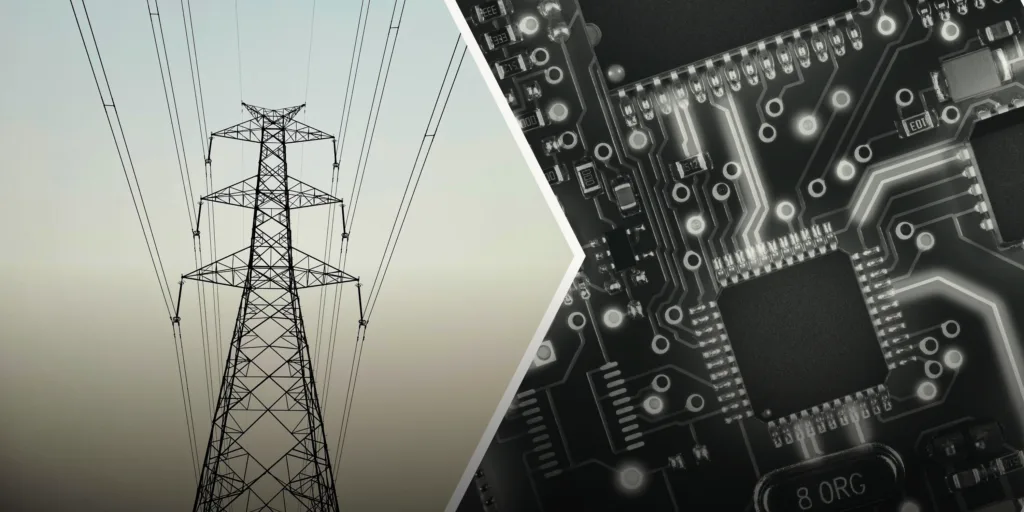
European semiconductor policy treats Taiwan as a supply-chain problem of fabs, capacity, and critical materials. It overlooks the one input that underpins every advanced wafer made on the island: electricity.
Key takeaways:
-
More than 90% of the world’s most advanced chips are made in Taiwan, and every one of those fabs is a major electrical load. A single advanced fab draws roughly 200 megawatts, and TSMC alone could account for close to a quarter of Taiwan’s electricity consumption by 2030.
-
Taiwan’s power equation is tightening on both sides. No nuclear power returns to the grid before about 2028, LNG reserves cover roughly eleven days of consumption, and Taipei has just doubled its ten-year demand forecast because of rising demand from chipmaking and AI. Taiwan already treats electricity as a binding constraint on its own chip industry.
-
EU semiconductor governance, including the June 2026 Chips Act 2.0 proposal, monitors capacity, materials and equipment chokepoints, but no Taiwanese energy indicators. Adding an energy layer to Chips Act monitoring and treating energy cooperation with Taiwan as chip-supply insurance would cost little and require no new institution.
Europe’s semiconductor exposure to Taiwan is among the best-documented dependencies in EU economic policy. More than 90% of the world’s most advanced chips, those below 10 nanometres, are manufactured in Taiwan. Taiwanese semiconductor giant TSMC’s 3- and 2-nanometre lines, which produce chips for the newest AI and flagship processors, are currently replicated nowhere else. The United States re-entered the leading edge only in late 2025, when Intel’s 2-nanometre-class 18A process reached volume production in Arizona; the European Union has no equivalent in sight.
The 2023 European Chips Act mobilized €43 billion to double the EU’s share of global production to 20% by 2030, a target the European Court of Auditors has judged “essentially aspirational.” The Commission’s Chips Act 2.0 proposal of June 2026 sharpens the diagnosis without changing the frame: it strengthens supply-chain monitoring with a business-to-business platform and an early-warning indicator list, and directs strategic mapping towards value-chain segments, third-country dependencies and geopolitical risk. Energy appears in the text as an efficiency and cost variable for European producers, not as a supply condition in the economies on which Europe depends.
Meanwhile, the flagship diversification project on European soil, the TSMC-led ESMC fab in Dresden, will produce at the 28/22 and 16/12-nanometre nodes when it comes online in 2027. That is valuable for automotive and industrial chips, but it sits two generations behind the leading edge. Throughout the Chips Act’s current time horizon, European access to advanced logic will run through fabs in Hsinchu, Taichung and Tainan.
What EU policy does not register is that these fabs are, physically, enormous electricity loads. A single advanced fab draws roughly 200 megawatts, according to Taipower’s chairman, comparable to the consumption of a medium-sized European city. TSMC alone already accounts for close to 10% of Taiwan’s electricity consumption, and S&P Global has projected that its share could approach 24% by 2030 as extreme ultraviolet (EUV) lithography scales. European chip security therefore depends, in part, on the future output of a single island utility. And meeting that demand is becoming more difficult.
Taiwan’s power equation is tightening on both sides
On the supply side, Taiwan relied on imports for about 95% of its energy needs in 2025, including more than 99% of its oil and natural gas. In May 2025, it shut down its last operating nuclear reactor, completing a phase-out pursued since 2016. That policy has since begun to reverse: days before the final shutdown, the legislature amended the Nuclear Reactor Facilities Regulation Act to allow reactor lifetimes of up to 60 years; in November 2025 the Ministry of Economic Affairs approved a Taipower assessment finding the Kuosheng and Maanshan plants feasible to restart; and in March 2026 Taipower filed the Maanshan restart plan with the Nuclear Safety Commission, which opened its review the following month.
Independent safety inspections will take 18 to 24 months, meaning no nuclear power returns to the grid before about 2028, with both plants fully operational around 2029 at the earliest. Tellingly, the ten-year power development plan the ministry presented in June 2026 does not yet include nuclear in its supply projections: it instead bets on roughly 26 gigawatts of new gas-fired capacity by 2035.
On the demand side, the same June 2026 revision doubled the growth outlook: electricity consumption is projected to grow by 2.5% per year on average through 2035, twice the pace of the past decade, driven largely by chipmaking and AI. Taipower expects the semiconductor sector to add more than 5 gigawatts of demand by 2030 as 2-nanometre production ramps up and fabs for 1.4-nanometre processors and high-bandwidth memory are built.
Government projections see AI data-center electricity use rising eightfold between 2023 and 2028, and the economics ministry has begun tightening reviews of data-center projects above 5 megawatts. An amendment to the Energy Management Act, cleared by the cabinet in May 2026 and approved in preliminary review by the legislature’s economics committee in August, would go further, requiring the largest consumers, potentially around 700 companies under the threshold being discussed, to install their own generation and storage. Taiwan, in short, is already treating electricity as a binding constraint on its own chip industry. Europe has not caught up with that insight.
Eleven days of margin
The swing fuel in this equation is liquefied natural gas (LNG), which fuelled 47.8% of Taiwan’s electricity generation in 2025, just short of the government’s 50% target. Yet LNG is difficult to stockpile at scale, and the island’s reserves cover around 11 days of consumption, against roughly 40 days for coal and 140 for crude oil. The government aims to reach a 14-day LNG buffer by 2027, and Chinese blockade exercises have rehearsed severing exactly these flows. At the margin, every EUV scanner in Tainan depends on a tanker that docked within the past two weeks.
None of this means European chip buyers should expect fabs to go dark. Taipower prioritizes industrial users, and official projections show the reserve margin improving from 12.8% in 2026 to over 20% after 2030, provided the gas build-out arrives on schedule and demand behaves as forecast. The more important issue is the trough: the same report puts the nighttime margin at 7.1% in 2029, while Taipower’s own planning presentation is tighter still. Demand, meanwhile, continues to concentrate in a handful of science parks served by strained north-south transmission corridors.
The risk to Europe is not primarily the blockade scenario that dominates strategic commentary. What deserves more attention is the slower one: structural scarcity expressed as connection moratoria (Taipower has approved no large new data-center connection north of Taoyuan since 2023), curtailed expansion plans, rising industrial tariffs and investment decisions quietly shifting elsewhere. In that world, the constraint never shows up as an outage. It shows up as slower growth in the advanced-node capacity Europe depends on, and a higher marginal cost for every chip it imports.
|
Indicator |
Figure |
| Share of global advanced-chip production (below 10 nm) located in Taiwan | Over 90% |
| Energy import dependency (2025) | About 95% overall; over 99% of oil and gas |
| Nuclear share of electricity generation | 0% since May 2025; restart no earlier than ~2028 |
| LNG share of electricity generation (2025) | 47.8% |
| Strategic fuel reserves | LNG ~11 days; coal ~40 days; crude oil ~140 days |
| Average electricity demand growth forecast (2026-2035) | 2.5% per year (vs. 1.2% over the past decade) |
| Additional semiconductor power demand by 2030 | Over 5 GW (~1 GW per year); one advanced fab ~200 MW |
| TSMC share of Taiwan’s electricity consumption | ~10% today; up to 24% by 2030 (projection) |
Table 1. Taiwan’s electricity constraint at a glance. Sources, by row: SIA/BCG; Atlantic Council; World Nuclear Association and Nuclear Engineering International; Energy Administration, via CNA; CSIS and MOEA; MOEA, via Taipei Times; Taipower, via Tom’s Hardware; S&P Global Ratings, via Taipei Times.
The EU’s semiconductor governance does not see any of this. The European Semiconductor Board tracks capacity, critical materials and equipment chokepoints; scenario work on Taiwan contingencies focuses on shipping, stockpiles and export controls. Taipower’s reserve margin, Taiwan’s LNG stock-days and fab-connection curtailments appear nowhere in this architecture as indicators of European supply risk, although that is precisely what they are.
First, add an energy layer to existing monitoring. A handful of indicators, including reserve margin, LNG stock-days, connection moratoria, industrial tariff decisions and curtailment events, could be tracked within the Chips Act coordination mechanism in much the same way as fab utilization and materials flows are tracked today. The Chips Act 2.0 negotiation, which creates a formal early-warning indicator list, is the obvious vehicle. This costs almost nothing and could be operational within months.
Second, treat energy cooperation with Taiwan as chip-supply insurance. European firms already sit deep inside Taiwan’s energy transition: under a corporate power purchase agreement signed in 2020, TSMC takes the entire 920-megawatt output of Ørsted’s Greater Changhua 2b and 4 offshore wind farms. Every megawatt added or saved on the island helps de-risk European chip supply as surely as a subsidized fab in Dresden, at a fraction of the cost and with commercial returns attached.
Third, stress-test European industrial planning against a power-constrained Taiwan, not only a blockaded one. What happens to European automotive electrification and AI deployment timelines if Taiwan’s advanced-node expansion slips by two years for energy reasons? That question deserves the same scenario treatment as a Taiwan Strait crisis already receives.
Fourth, name energy explicitly in EU-Taiwan economic dialogues. Energy-resilience cooperation is commercial and technical; it is already happening between firms, and it crosses no political red lines. The gap is that Brussels treats it as incidental business rather than a strategic complement to semiconductor policy.
Until at least 2030, the marginal advanced chip consumed in Europe will be produced in Taiwan. Whether it arrives on time and at competitive cost will depend less on wafer starts alone and more than European policymakers currently acknowledge on turbines, terminals and grid reinforcement on an island that stores eleven days of its dominant fuel. Europe cannot rebuild the leading edge at home this decade; its own auditors have said as much. What it can do is help keep the lights on where the leading edge lives and, at minimum, start watching the meter. A de-risking strategy that counts fabs but not megawatts is not security policy. It is bookkeeping.