Key takeaways:
-
As its trade deficit with China continues to widen and transatlantic commitments become increasingly uncertain, the EU is now questioning both the nature of its ties to Beijing and the strength of its relationship with Washington.
-
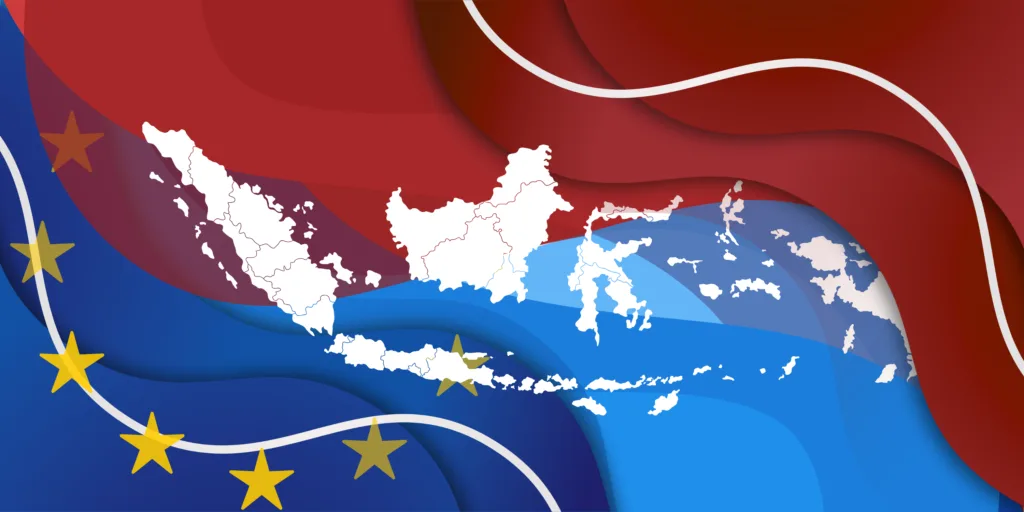
Amid this, the EU continues to pursue its strategic diversification efforts, including through new trade agreements such as the EU-Indonesia Comprehensive Economic Partnership Agreement (CEPA).
-
The opportunities and challenges of deepening EU-Indonesia ties, however, must be assessed and understood by both Brussels and Jakarta on equal terms.
European relations with China are at an impasse. The EU’s trade deficit with China is unlikely to improve anytime soon, as European exports to China continue to decline while imports from China continue to rise, while the Trump administration’s increasing embrace of protectionism has disrupted global markets and trade flows through increased tariffs, quotas and other trade-defensive measures. At the same time, the negotiating space between the EU and China has narrowed as both sides adopt increasingly protectionist policies. In this environment, long-standing disputes over state subsidies, market access, and industrial policy are becoming even harder to resolve. In response, the European Commission is now reassessing its trade-defense toolkit to see whether it can more quickly and effectively counter threats emanating from both China and the United States.
Europe’s ongoing supply chain problems
Beyond its direct trade exposure, Brussels has also become more alert to the bottlenecks and supply chain vulnerabilities that can be weaponized against European interests. In the case of China, these vulnerabilities are especially acute in critical raw materials and strategic technologies, including components such as lithium-ion batteries. The consequences are far-reaching, particularly for industries such as automotive manufacturing and defense.
In October 2024, the European Commission concluded its anti-subsidy investigation into Chinese-made battery electric vehicles (BEVs). After determining that China’s BEV value chain was benefiting from “unfair” state subsidies, the Commission imposed countervailing duties on BEV imports from China, though these have since been dropped in favor of price undertakings in several cases. Both the EU and China have subsequently threatened to take further defensive measures. In February 2026, the EU even initiated a WTO dispute against China over China’s practice of setting binding royalty rates for portfolios of standard essential patents without the consent of the patent holders.
While measures like these address symptoms rather than the root causes of the EU’s economic problems, there are indications that EU-China economic ties may worsen further in 2026, with several analysts noting that the EU’s key challenge lies in defining a strategic approach to China that goes beyond defensive measures. Moreover, as Beijing increasingly sees Europe as both powerless and leaderless, it is imperative that the EU proves China wrong through an intricate balancing act that will reduce its dependencies on China without “rocking the boat too hard.”
The EU-Indonesia CEPA as a diversification pillar
The EU’s free trade agreement (FTA) with Indonesia, signed in December 2025 and expected to take effect by 2027, can serve as a potential diversification route for Europe amid its ongoing disputes with China and distortions from the US, especially as it can be used not only to increase the EU’s market access but also to diversify its supplies of energy and raw materials.
Thanks to the FTA, the EU exporters may save over €600 million in customs duties when entering the Indonesian market, while more than 98.5% of Indonesian tariffs on European products, including meat, vegetables, fruit, dairy, and a wide range of processed foods, will be removed. Thus, the EU hopes the FTA will boost Indonesian consumers’ appetite for European agricultural products, framing it as a major win for European farmers. This is important, as with annual exports valued at €1 billion, the bloc exports more food and agricultural products to Indonesia than it imports, and the FTA protects 221 EU agricultural and food Geographical Indications (GIs), whereas it protects only 72 Indonesian GIs.
This, of course, does not mean that the archipelago will not benefit from the FTA, quite the contrary. One million tons of Indonesian crude palm oil, once a hotly debated issue in EU-Indonesia ties, will be allowed to enter the European market duty-free each year, with imports exceeding this quota subject to a 3% tariff.
Most importantly, the FTA has the potential to contribute to the two countries’ green and digital transitions. Indonesia’s position as a world-leading producer of critical raw materials, especially nickel and cobalt, could fundamentally reshape the EU’s strategic calculus in Southeast Asia, as it presents a significant opportunity for Europe to diversify its supply chains away from its excessive dependence on China, though the significant constraints resulting from Indonesia’s embeddedness in Chinese value chains and reliance on Chinese capital should not be underestimated. In any case, the EU-Indonesia CEPA can act not merely as another trade agreement but as a strategic instrument through which Brussels could institutionalize its access to key materials while managing geopolitical and economic risks in an increasingly fragmented global order.
Leveraging the EU-Indonesia CEPA for strategic purposes
Beyond the FTA’s many economic promises, Indonesia’s non-aligned yet pragmatic geopolitical stance and strategic location make the archipelago a worthwhile partner in the Indo-Pacific. Therefore, the EU should move beyond a narrow focus on securing resources and opening new markets, and consider anchoring Indonesia as a central hub in its Indo-Pacific diversification strategy.
Indonesia’s geographic position places it strategically astride key global shipping routes, notably the Malacca, Lombok, and Makassar Straits. Even for a global economic power like China, Indonesia’s geographical importance cannot be denied. For example, in 2023, 53% of China’s energy imports from the Middle East passed through either the Strait of Malacca or Indonesian-administered maritime corridors. China’s exposure is most pronounced at Malacca, where about two-thirds of its maritime trade by value converges, while other vessels are diverted through secondary routes across Indonesia’s archipelagic waterways. Indeed, given its geographic position between the Indian and Pacific Oceans, several analysts have pointed out that Indonesia’s sea lanes would assume major strategic importance in the event of a Western Pacific contingency.
The EU’s Critical Raw Materials Act should also form an essential part of the bloc’s security agenda in the Indo-Pacific. Rather than simply encouraging companies to relocate their value chains, the EU needs to first address several substantive limitations in its own critical raw materials sector, including structural and institutional ones, particularly the lack of financial incentives and the low profitability of processing and refining activities.
This means any EU involvement in the Indonesian nickel value chain should avoid pursuing one-sided transactional deals that would primarily benefit the EU and instead align its strategy with Jakarta’s own policy goals of value retention and technology transfer.
Realistically, China’s dominant role in processing critical materials and midstream components means that China-free supply chains between the EU and Indonesia are highly unlikely, at least in the near future. What the EU could do, however, is to build deeper bilateral ties with Indonesia grounded in value-chain cooperation and mutually beneficial technology and industrial partnerships, which could mark a first step in its ongoing efforts to diversify its supply chains away from Chinese intermediaries.
Indeed, China’s dominant role in Indonesia’s nickel value chains is emblematic of both the opportunities and risks that arise from allowing a single great power to control a strategic nucleus in global supply chains. While Chinese capital and technology have accelerated downstream activities and export growth, in the process transforming Indonesia into a major nickel supplier to the global market, this dominance has structurally tied the Indonesian nickel industry to China, thereby creating a new dependency that limits Indonesia’s ability to increase its own value-added while also increasing its exposure to global supply chain risks.
Understanding these dynamics can help the EU design a gradual diversification strategy that takes into account its own dependencies on processing capacity and technology dominated by Chinese actors, such as by engaging more global partners in mineral processing, building new capacity, and reducing the bottlenecks imposed by Chinese companies that control about 75% of Indonesia’s nickel-refining capacity.
Meanwhile, Indonesia needs to gradually strengthen its export-oriented manufacturing sector, which could directly benefit from the proposed tariff eliminations under the CEPA. Given the domestic political economy and ongoing productivity challenges, this transformation will likely be incremental, with an initial focus on sectors with potential for increased value-added, as Indonesia’s structural transformation remains gradual.
Agriculture still accounts for a substantial share of GDP, and manufacturing’s contribution has stagnated at around 19% over the past eight years, not to mention concerns highlighted by the World Bank regarding the sector’s productivity performance. The archipelago should also seek to leverage the EU-Indonesia FTA to enhance its regulatory standards by aligning its ESG standards with the EU’s, which could not only expand export opportunities but also increase the competitiveness of Indonesian products in global markets.
Jakarta should also enhance its investment facilitation mechanisms, especially those aimed at European firms active in minerals refining, electric vehicles, and green infrastructure. These mechanisms include fiscal incentives such as tax holidays, tax allowances, exemptions from machinery import duties, and one-stop services to accelerate investment in the downstream mineral, EV, and green infrastructure sectors.
Calculated risks, strategic gains
It goes without saying that trying to use the EU-Indonesia CEPA as a tool of strategic diversification, whether by Brussels or Jakarta, will be easier said than done. The ratification timeline itself remains uncertain.
At the same time, as the US appears to be turning away from its transatlantic allies and as China is pursuing a divide-and-conquer strategy in Europe, Brussels and Jakarta could try to jointly address the China challenge. One way to do this is to create a strategic platform for cooperation on critical minerals. This platform could be established under the CEPA framework to focus on joint feasibility studies and co-financing of ESG-compliant nickel-refining projects in existing industrial areas.
The EU and Indonesia could also establish new bilateral or multilateral dialogues, the latter of which could include other ASEAN countries, focused on mineral value chains, especially in the following three areas: transparency of production, ownership, and export data; harmonization of sustainability and supply-chain due diligence standards to ensure compatibility with EU regulations; and systematic mapping of refining capacity and downstream investment needs to identify joint projects that would reduce risks associated with a single dominant actor.
With this technical focus on data, standards, and concrete projects, the proposed dialogues will not be limited to occasional statements of support but will directly target structural barriers in the global minerals value chain by increasing market transparency, reducing regulatory hurdles between the EU and regional partners, and facilitating the cross-border coordination of investments needed to develop alternative processing capacities.