Welcome to the 69th issue of the CEEasia Briefing.
In this issue, we dissect the following topics:
- Europe – India relations
- Czechia & Taiwan strengthen cooperation
- Slovak President visits Japan
If you like what you see, please forward this message to your friends and colleagues who can subscribe here.
1. Europe and India pursue closer relations
What’s going on? The EU’s Political and Security Committee (PSC), led by Chair Ambassador Delphine Pronk and joined by ambassadors from all 27 Member States, paid its first-ever visit to India in September. At the same time, EU Commissioner for Trade Maroš Šefčovič traveled to New Delhi for two days to meet Indian Minister of Commerce and Industry Piyush Goyal for the 13th round of negotiations on the EU–India Free Trade Agreement (FTA).
Going deeper… EU’s PSC delegation, which is a vital body in shaping the EU’s foreign, security, and defense policy, held meetings with Indian government leaders, private defense industry representatives, civil society organizations, and leading think tanks. They discussed foreign policy alignment, security, and defense cooperation—particularly in the run-up to the EU–India Summit planned for early 2026. Shortly after the visit, the European Commission and the High Representative released a Joint Communication outlining a “New Strategic EU–India Agenda,” a framework emphasizing trade and investment—especially finalizing the FTA—alongside cooperation more broadly. The agenda will require ratification by all 27 Member States before formal adoption outlined for the 2026 Summit. Meanwhile, Šefčovič’s visit—the third to India this year—reaffirmed the shared ambition to conclude the EU–India FTA by the end of 2025, with the automotive sector expected to take center stage through reciprocal tariff liberalization.
This means… Staring in US-India relations and the ever-present China factor underscore the strategic importance of closer EU–India ties. Beyond the trade agreement, both sides are also looking to deepen their cooperation in defense and strategic sectors, as demonstrated by the new strategic agenda for bilateral relations, putting their partnership in a wider geo-economic and security context. Stumbling blocks in the FTA talks, however, remain – mainly when it comes to agriculture and dairy. Disagreements also persist over the EU’s Carbon Border Adjustment Mechanism (CBAM) and market access in automobiles, alcohol, and pharmaceuticals. During the last round of talks in Delhi, progress was made in some sectors, but the heavyweights mentioned above are still open. The next round of talks will take place this month in Brussels and will provide more insights into whether the FTA is likely to be finalized in the near future.
2. Czechia-Taiwan cooperation
What’s going on? Czech Minister for Science, Research and Innovation Marek Ženíšek traveled to Taiwan for a working visit, where he held an official meeting with Wu Cheng-wen, Taiwan’s Minister of Science and Technology. He also visited the headquarters of Taiwanese companies Foxconn and Advantech, both of which have operations in the Czech Republic. In addition, Ženíšek participated in SEMICON Taiwan 2025, one of the most influential semiconductor conferences in the world. During the event, he officially opened the Czech Pavilion, which featured leading Czech technology companies, academic institutions, and research and development organizations.
Going deeper… Ženíšek’s trip highlights the broader surge in Czech–Taiwan engagement across both the political and economic spheres. Czechia has maintained a national pavilion at SEMICON Taiwan for three consecutive years (2023–2025), underlining its ambition to anchor itself more firmly in the European semiconductor ecosystem. The visit also fits into a wider trend of intensified exchanges over the past few years between Prague and Taipei, which have exchanged numbers of high-level missions, including visits by parliamentary and government officials, and business delegations. This growing density of political contact has gone hand in hand with a steady rise in Taiwanese technology companies establishing operations in Czechia, a trend which Ženíšek’s trip sought to further reinforce.
This means… Two Taiwanese firms announced concrete steps to base their European operations in Czechia. CTi Cable (Ching Tai Electric Wire & Cable) will launch production near Prague, as early as September 2025, focusing on automated production of data cables and connectors. C-Tech United has opened its first European representative office in Prague and plans to begin local manufacturing of Li-ion and Li-polymer batteries by the end of next year. In the longer term, the company is also considering the establishment of a research and development center. These investments underscore Czechia’s rising profile as a hub for Taiwanese high-tech investment in Europe, complementing the existing footprint of firms such as Foxconn and Advantech.
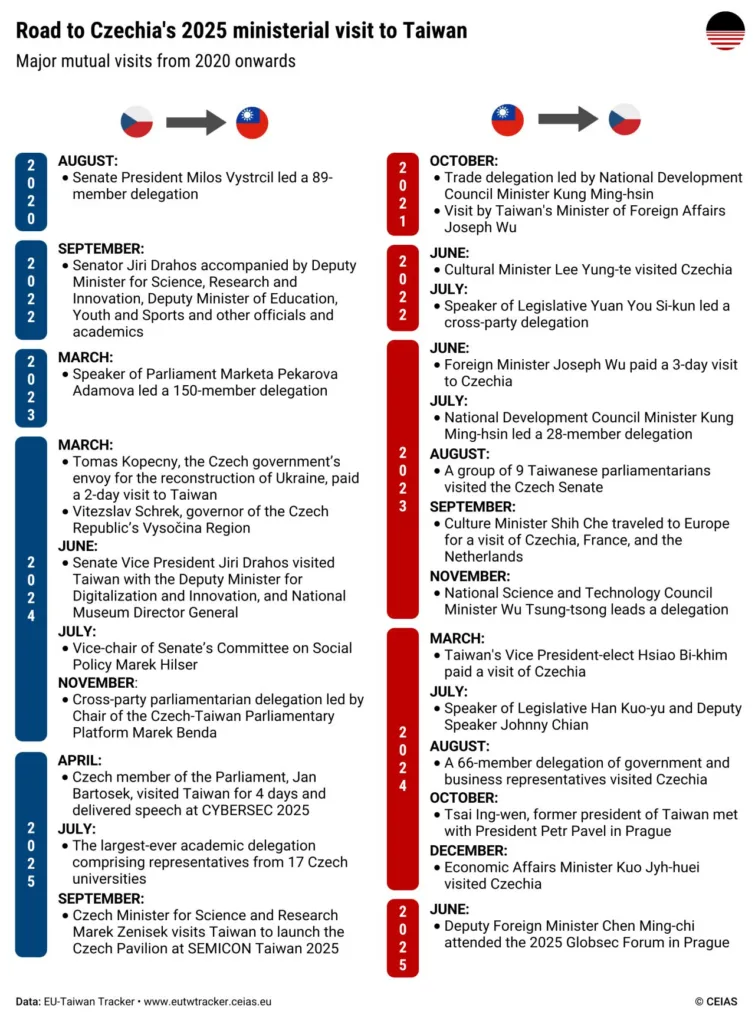
Moreover… The visit also carries a clear geopolitical dimension. Strengthening ties between Czechia and Taiwan comes at a time when the European Union is actively seeking to diversify supply chains and reduce overdependence on China. Beyond high-level political gestures, the steady increase of direct Taiwanese investment in Czechia shows that Prague is positioning itself not only as a political partner of Taipei but also as an economic gateway within the EU. Yet it also risks provoking criticism from Beijing, which has consistently opposed closer engagement between Taiwan and EU member states.
3. Slovak President visits Japan
What’s going on? Slovak President Peter Pellegrini visited Japan in September as an official guest of EXPO 2025 in Osaka‐Kansai. During his visit, he met with Japanese Prime Minister Shigeru Ishiba in Tokyo, and also took part in Slovakia’s National Day at EXPO on 10 September. Separately, a delegation led by the Speaker of the National Council Richard Raši met Masakazu Sekiguchi, President of Japan’s House of Councilors, in Tokyo the same month. Talks focused on strengthening bilateral relations, boosting economic cooperation, and preparing a strategic partnership agreement between Slovakia and Japan.
Going deeper… There are signals suggesting both Slovakia and Japan are intent on deepening their strategic cooperation on various issues. During the meeting between the Slovak President and the Japanese Prime Minister, both sides agreed to step up bilateral security cooperation. Ishiba stressed the need to deepen ties with Slovakia – a member of both the EU and NATO – given the worsening global security environment. Pellegrini affirmed his commitment to stronger cooperation across multiple fields. The leaders also discussed Russia’s war in Ukraine and North Korea’s nuclear program, pledging to tackle international security challenges together. Similarily, emphasis on strategic cooperation was also reflected during the meeting between the Slovak House Chair and Japan’s President of the House of Councilors; in addition to placing importance on decades of business cooperation, Raši called Japan a key Indo-Pacific partner and invited Sekiguchi to visit Slovakia.
This means… Japan’s strengthening ties with European countries—and Europe’s reciprocal outreach to Japan—reflect a shared effort to diversify strategic partnerships and balance China’s growing influence as well as the evolving relationship of the EU and the US. At the same time, the recent activity in Slovak-Japanese relations marks an extension of Japan’s broader effort to strengthen cooperation with NATO and its European partners in recent years.
Quick takes on CEEasia developments
CHINA | On September 10, Beijing imposed preliminary anti-dumping duties of up to 62.4% on pork meat and pig by-products imports from the EU. The provisional duties result from a Chinese investigation that started in June 2024, a few days after the EU imposed provisional tariffs on Chinese EVs.
CHINA | Poland reopened its border with Belarus on 25 September after a nearly two-week closure prompted by Russia-Belarus military drills and recent Russian drone incursions into Polish airspace. The shutdown disrupted a trade corridor worth around €25 billion annually, vital for EU-China e-commerce flows powering platforms like Temu and Shein. While Beijing urged Warsaw to restore traffic, Polish officials said “logic of security” outweighed economic costs.
INDONESIA | After nearly a decade of negotiations, the EU and Indonesia signed a Comprehensive Economic Partnership Agreement and an Investment Protection Agreement in Bali at the end of September. The deal will eliminate most tariffs on key exports such as car parts, agriculture, pharmaceuticals, palm oil, textiles, and fisheries, and is expected to take effect by 2027 after ratification.
JAPAN | Japanese Foreign Minister Takeshi Iwaya and Hungarian Foreign Minister Péter Szijjártó met in Japan in September to discuss cooperation in space technologies, nuclear energy, and to exchange views on the war in Ukraine and upholding of international law. During his visit, Minister Szijjártó also inaugurated a new Hungarian consulate in Osaka to strengthen economic, political, and people-to-people ties.
TAIWAN | Taiwan Foreign Minister Lin Chia-lung led a delegation to the Czech Republic (Sept. 11–13) to open the 100 Treasures, 100 Stories exhibition, showcasing National Palace Museum artifacts as part of the Taiwan Culture in Europe 2025 initiative and highlighting close Taiwan–Europe cultural ties. Besides Czechia, Minister Lin also visited four other EU member states in September—Italy, Austria, Poland, and the Netherlands.