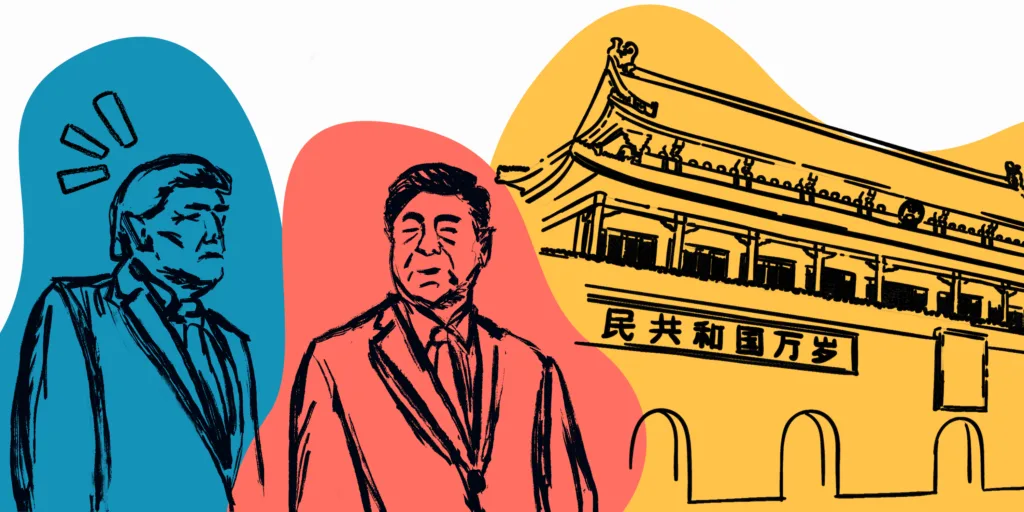
Donald Trump has just returned from his three-day trip to Beijing, which took place between May 13 and 15. It was the first visit to China by a sitting US president since Trump’s visit in 2017, following a rather hectic year marked by escalatory tariffs and export controls. The former reached 145% at one point and was put on hold only after the two leaders’ October 2025 meeting in Busan, South Korea. Even if the EU was not in the room, many of its own interests were on the table, whether it was rare earths or semiconductor export controls.
We approached several of our researchers to share their insights on the importance of this meeting, including its meaning and potential implications for the future development of not just US-China but also transatlantic and EU-China relations, with a particular focus on economic, technological, cross-Strait, and political aspects.

Geo-economics reigns supreme
Dominika Remžová, CEIAS Research Fellow
In line with pre-summit expectations, the summit did not produce any substantive outcomes, the main one being the seeming intent to prolong the trade truce agreed upon in Busan. This would give both leaders some much-needed breathing space to deal with their respective domestic issues—including the inflationary pressures, the cost-of-living crisis, and both the internal and external consequences of Trump’s war in Iran in the case of the US, and deflationary pressures, the demographic crisis, and decreasing productivity in non-high-tech sectors in the case of China.
While the post-summit statements by Trump and the White House mention concrete deliverables in terms of US exports of beef, soybeans, and crude oil, as well as China’s commitment to purchase 200 Boeing aircraft (well below the 500 anticipated and the 300 promised in 2017), these were not confirmed by the Chinese readouts. Instead, the Chinese statements remained broad and vague, focusing on highlighting the “win-win” outcomes and the new paradigm for US-China relations termed “constructive strategic stability,” in stark contrast to the more negative assessment of stalemate proposed by many.
The announced increase in agricultural exports (even if it does not materialize) could help Trump address his low approval ratings ahead of the November mid-term elections. At the same time, the lack of (public) discussion on the more structural issues in the relationship was noteworthy, namely China’s neo-mercantilist policies and the ever-increasing trade deficit, as well as China’s access to the US market and a breakthrough regarding Nvidia’s sales of H200 chips needed for AI development (see below).
The announced intent to institutionalize the existing relationship through Boards of Trade and Investment can indeed produce some (surface-level) stability. However, as these mechanisms pertain mainly to the management of tariffs and investments in non-sensitive areas, the structural asymmetries underlying the two country’s widely different growth models and their geo-economic externalities—increasingly marked (though not solely) by zero-sum power dynamics, as seen in the context of the tech race—will continue to complicate any long-term stability (let alone rapprochement) in the relationship, thereby contradicting the “partners, not adversaries” framing of the talks.

Washington holds the line on AI chips controls
Filip Šebok, Head of CEIAS Prague Office
The competition in AI has become one of the most dynamic arenas of the US-China relationship. However, the Beijing meeting seems not to have produced any major new developments, despite the last-minute addition of Jensen Huang of NVIDIA to the US delegation. One exception was news that the US and China were reportedly working to develop a consensus on guardrails for AI development and to prevent non-state actors from accessing advanced models.
The leading figures in the Trump administration and also the US industry leaders remain divided on how to approach China in the AI sphere. Anthropic has been leading the charge in arguing that the US needs to keep its leadership ahead of China in the AI race under all circumstances, painting an alarmist picture of China emerging victorious in the race of AGI in its recent paper, should the US relax its export control policies or weaken its response to China’s distillation efforts.
For his part, Jensen Huang has been the most prominent advocate of loosening the restrictions on US AI chips exports to China, arguing that it is in the US interest to keep China dependent on the US AI tech stack. NVIDIA secured the Trump administration’s approval for exporting its less-powerful H200 chips to China in January. However, no sales have proceeded so far, even as the US administration has cleared 10 Chinese companies to purchase the chips.
The Chinese government itself has not jumped at the US offer, fully aware of Washington’s intention to keep China dependent on second-generation technology. While Chinese tech leaders are starved for compute, leaders in Beijing would like to reduce their current reliance on the US and use the opportunity to boost homegrown AI chip champions that are still far behind their US competitors. This was also evidenced by Beijing’s decision to block META’s acquisition of Manus, a Singapore-based but China-founded AI agent start-up.
In practice, the Trump administration has not significantly relaxed its AI chips control policy, and the H200 sales, if they eventually go through, are unlikely to provide a significant boost to China’s efforts. Beyond chips alone, the US is also expanding controls across the broader semiconductor supply chain. A new congressional proposal would require market-leading Dutch and Japanese equipment manufacturers to comply with US export controls and further limit their business with Chinese customers. Thus, even with Trump’s interest in deal-making and a record of erratic rhetoric on the issue, the US-China AI competition appears too entrenched to expect any major policy reversal.

Temporary respite amidst rocky future for Taiwan
Matej Šimalčík, CEIAS Executive Director
Taiwan can breathe a little easier, at least for now. Before the summit, it was widely speculated (both in and out of Taiwan) that the island democracy could be sacrificed as part of a broader US-China deal. In an ideal scenario for Taipei, Taiwan would not be mentioned in the negotiations or in their readouts at all, in the hope that the two superpowers would focus on the myriad other issues that plague their bilateral relationship. But this was a far-fetched hope at best, given Taiwan’s central place in the strategic thinking of both the United States and China.
In the end, Taiwan got the next best thing. Beijing reiterated its familiar claim to Taiwan in the official PRC readout, calling Taiwan “the most important issue in China-US relations” and warning Washington to handle it with caution. But US Secretary of State Marco Rubio confirmed that the “US policy on the issue of Taiwan is unchanged.” Hence, strategic ambiguity, backed by continued supplies of military hardware (the latest package worth $11bn was approved last December), remains the official US policy for now.
Major shifts in US policy on Taiwan also appear improbable in the longer term, despite the mercurial nature of American foreign policy under President Trump. Taiwan remains indispensable to the US (and global) economy due to the position of its semiconductor industry in tech supply chains. Its location on the first island chain also gives it lasting strategic value for US efforts to deter Chinese naval expansion into the Pacific. Nevertheless, this does not mean that Taiwan can relax just yet. Tensions across the Taiwan Strait remain high; domestic polarization and the opposition’s cozy ties to Beijing complicate policymaking; and the Trump administration remains skeptical of Taiwan’s pace of arms procurement and military readiness.
That said, Taiwan’s relationship with the US won’t be smooth sailing for the remainder of the Trump presidency. Trump has signaled that future arms sales to Taiwan may be used as leverage in dealings with Beijing. At the same time, this is as much a bargaining chip towards Taipei as Trump pushes for more of Taiwan’s semiconductor industry to expand to the US, hoping to have as much as 40-50% of the industry by the end of his second term in office.
Taken together, those two impulses mean Washington is likely to keep supporting Taiwan, but in a more transactional and less predictable way than Taipei would prefer. In this context, Taiwan’s future continues to look rocky.

Who’s “daddy” in Beijing?
Richard Turcsányi, CEIAS Program Director
Unlike NATO Secretary General Mark Rutte, who infamously called the American president “daddy”—a label Trump clearly enjoyed—that was not the optic we saw in Beijing. If anything, the meeting suggested two equals, though there are also reasonable grounds to argue that the United States may now be in a somewhat weaker negotiating position vis-à-vis China.
Donald Trump seemed to go out of his way in Beijing to show respect and signal friendship to his host, Xi Jinping. He repeatedly tapped Xi’s hand, patted his back, leaned forward, and displayed a degree of warmth that is not usually associated with Trump’s style. He also repeatedly praised Xi as a great leader. At times, Trump appeared more eager to establish rapport with the Chinese president than vice versa.
The American president also seemed unusually restrained. He stuck closely to protocol, read from prepared remarks, and did not engage in the kind of spontaneous exchanges with reporters that he often favors. Trump was either genuinely impressed or wanted to appear so during the visit. While he maintained the long-standing American ambiguity over Taiwan, he did appear to advise the “person that right now is running Taiwan” not to cause trouble. Some of his remarks, such as those about how close Taiwan is to China geographically and how far it is from the United States, suggest that he at least partially accepted elements of China’s framing of the issue.
It will be important to watch future developments before drawing firm conclusions about the summit. Even so, it is easier to imagine Trump making concessions to China than the other way around. The US appears to have abandoned its earlier goal of pressuring China to change its economic model; the most Trump secured was a promise that China would buy American agricultural products and aircraft. China may still push Trump further before Xi agrees to visit the United States later this year. For instance, there could be pressure on Trump not to approve the sale of weapons to Taiwan.
Overall, the summit delivered little in substantive terms, but the optics were notable. At the very least, it suggests that the United States now treats China as a near-peer. Trump clearly seems to recognize that China has some important cards to play. He is certainly not “daddy” when he meets the Chinese president.